האחדות
The Unity
Shchunat Ezrat Yisrael, Yerushalayim · Since 1910
Tel Aviv Apartment

Tel Aviv Apartment

Author: David Nataf

  • Liepāja’s lighthouse memorial and the woman behind it: Ilana Ivanova (Zivson) at 80

    Liepāja’s lighthouse memorial and the woman behind it: Ilana Ivanova (Zivson) at 80

    By David Nataf

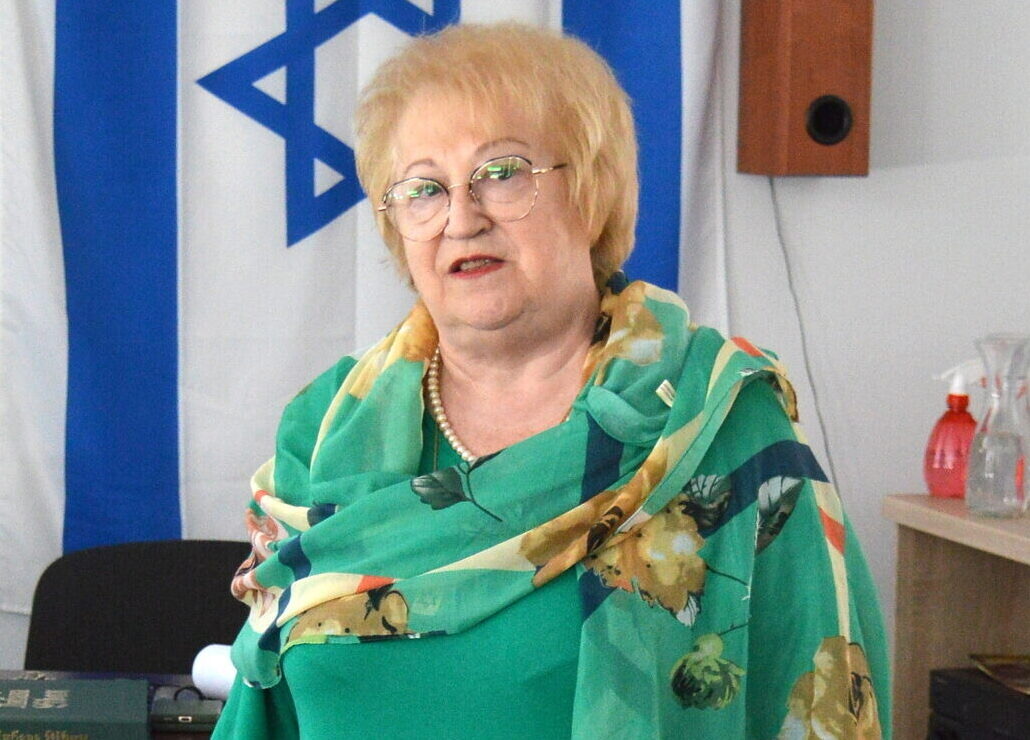
    LIEPĀJA, Latvia — Families from Israel stood beside the Baltic this summer as a new Holocaust memorial was dedicated at the Liepāja lighthouse, and much of what brought them there traces back to one woman. Ilana Ivanova (Zivson), the daughter of two survivors from this port, is celebrating her 80th birthday. I have long called her “the soul of this community, a living memory”.

    Watch: Liepāja unveils a memorial to the Jews of Central Europe (Uniting Fund on Facebook). Watch on Facebook

    Earlier this month, on 8 October 2026, another memorial was opened in Liepāja after restoration: the mass grave memorial in the Jewish section of the Livas Cemetery, commemorating the Jews from Central Europe who died in the city.
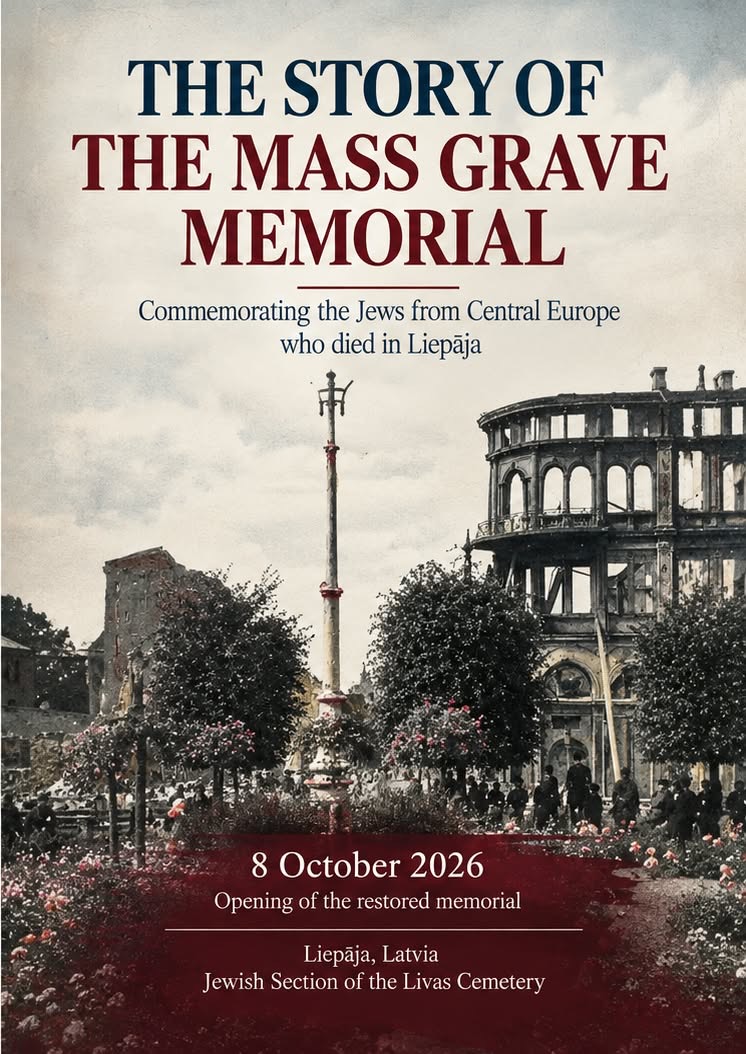
    Opening poster: restored Mass Grave Memorial for Central European Jews who died in Liepāja, Jewish section of Livas Cemetery, 8 October 2026
    Poster announcing the 8 October 2026 opening of the restored Mass Grave Memorial, Jewish section of Liepāja’s Livas Cemetery, honouring Jews from Central Europe.

    Descendants come home to the Baltic shore

    The dedication took place on 24 July 2026 at Roņu iela 8C. In the summer of 1941, that spot saw one of the earliest mass killings of the town’s Jews; the memorial now honours more than 2,000 people murdered there. After Šķēde, it is the second large site in Liepāja devoted to Holocaust remembrance.

    It was unveiled during the 13th World Reunion of the Jews of Liepāja, once known as Libau. Some 180 people from eight countries attended. Many had travelled from Israel; others came from America, Germany, Britain and beyond. With diplomats and municipal leaders at their side, they retraced the streets their grandparents had known.

    Those reunions are among the initiatives Ilana launched and organised, as listed in a document prepared by her daughter, Anna Petrova, who heads the Liepāja Jewish Religious Community and describes herself as belonging to the third generation after the city’s survivors.

    The dunes of Šķēde, and an alley honouring rescuers

    Long before the lighthouse, there was Šķēde. The Liepāja Jewish Heritage Foundation, active since 2004, raised a vast menorah among the sand dunes there to commemorate the murdered Jews of the town. Beyond it runs a path dedicated to the Righteous Among the Nations, inaugurated at the 2014 reunion while Israel’s ambassador looked on.

    Ilana’s list of projects goes further: memorial initiatives, exhibitions and conferences, educational and cultural programmes, and books of local history. One of them is an electronic volume entitled The Jewish Heritage of Liepāja in the Context of the City’s History. Another remembers Otto Fischer, an Austrian Jew who coached Olimpija Libau to a national championship and who was killed in 1941 for being Jewish. Today a plaque at the club’s stadium and a tournament for young players keep his name alive.

    In her daughter’s words, Ilana’s efforts turned what she inherited into books, monuments, gatherings, teaching and institutions meant to outlast her generation.

    A cellar, a Righteous rescuer and photographs smuggled out

    Why this cause? Because Ilana’s own story begins in hiding. Under German rule nearly 6,000 Jews lived in the town; of those present then, only about thirty survived to see it freed. Her parents, David and Henny Zivson, were two of them.

    Roberts and Johanna Seduls concealed eleven Jews in a hidden basement for nineteen months. Discovery could have come at any moment. Shortly before liberation, Roberts died, struck by shrapnel, yet his widow kept feeding and protecting the group until the end. Jerusalem’s Yad Vashem named Johanna Sedule Righteous Among the Nations in 1981.

    Ilana’s father risked even more. Pressed into service as an electrician by the German security police, he spotted pictures of the Šķēde shootings in the office of the SS officer Karl-Emil Strott and duplicated them in secret. The German Resistance Memorial Center states that his copies were produced as evidence at Nuremberg and at the Grauel trial.

    Kungu iela 21: a small congregation that refuses to disappear

    Remembrance is only part of Liepāja’s Jewish life today. In the community building at Kungu iela 21, members gather on Shabbat, read and study Torah, and mark Rosh Hashanah, Hanukkah, Pesach and other holy days. Concerts, talks and classes fill the calendar, and older members receive practical help. A museum on the community and its heritage is taking shape in the same building, intended to show the lives of Liepāja’s Jews and not merely their deaths.

    The congregation partners with the municipality, Jewish bodies in Latvia and overseas, foreign embassies and other partners, and it receives visitors from Israel and elsewhere who arrive in search of family roots.

    Anna Petrova admits the numbers of the prewar era will never return. Still, she writes, the community exists and is alive, and more than eight decades after the attempt to wipe it out, Shabbat candles are lit again in Liepāja.

    That flame owes much to her mother. Happy 80th birthday, Ilana: mazal tov, ad meah ve’esrim.

  • The Pilot Israel Already Knew About: Flydubai Attack Exposes a Gap in Israel’s Air Defenses on the Ground

    The Pilot Israel Already Knew About: Flydubai Attack Exposes a Gap in Israel’s Air Defenses on the Ground

    The Omani co-pilot’s passport details reached an Israeli database before takeoff. No agency checked them. A closed Knesset hearing now reportedly shows he was one of about 1,240 aircrew from countries without diplomatic ties to Israel who entered the country. Israel, the target of the attack, is now moving to close the gap.

    A week after the co-pilot of flydubai flight FZ1073 attacked his captain on the way from Dubai to Tel Aviv, Israel’s main question is why nobody on the ground stopped him from boarding.

    What happened on FZ1073

    According to Saudi Arabia’s Interior Ministry, a preliminary investigation found that “the pilot was assaulted by his co-pilot, resulting in various injuries to both.” The Boeing 737 MAX diverted to Prince Sultan bin Abdulaziz International Airport in Tabuk. It landed safely at 9:45 a.m. local time with 174 passengers and eight crew on board.

    On October 3, UAE Attorney General Hamad Saif Al Shamsi said investigators had found that the co-pilot “attempted to carry out a terrorist attack.” In a statement carried by the state news agency WAM, he said the co-pilot struck Captain Smit Machchhar, an Indian national, with the cockpit crash axe and tried to take control of the aircraft. Reuters, the Associated Press and the BBC have named the co-pilot as Hamam al-Hammami, an Omani national. UAE authorities have not confirmed his identity.

    The plane was saved in the cabin. Although badly wounded, Machchhar managed to open the cockpit door. Passengers, almost all of them Israelis, rushed in and overpowered the attacker, according to the Times of Israel and the BBC. Flydubai says an “on-duty flydubai crew travelling on the flight” then diverted the aircraft and landed it.

    A rule that existed only on paper

    Under its agreement to operate in Israel, flydubai was required to staff Israel-bound flights only with pilots from countries that have relations with Israel, the Jerusalem Post and Ynet report. Oman has no diplomatic relations with Israel.

    But Israel had the information it needed. A 2023 law requires every airline flying to Israel to send passenger and crew data in advance, including names, citizenship and passport details. The data goes to the National Passenger Data Analysis Center, which operates under the Israel Tax Authority. The Tax Authority has confirmed that the center received the full FZ1073 list, including the crew, before the flight, Globes and Ynet report.

    Nobody acted on it. According to several senior officials quoted by Ynet, the Transportation Ministry’s security division had not retrieved crew data on foreign flights for about two years. Citing the Wall Street Journal, Walla reported that the ministry had never requested the lists at all.

    Each agency now says the job belonged to someone else. Transportation Minister Miri Regev told Kan that the Mossad is responsible for foreign carriers and that the list “was not transferred to us.” Her ministry’s security division says it is “not an intelligence agency.” Ynet reports that the Mossad also says it did not receive the list. A security official told Walla that the Mossad does not screen crew lists on every foreign flight. Asked how many pilots from hostile countries had landed in Israel, the Civil Aviation Authority told reporters: “We estimate there were none. But we have no certainty.”

    Help had been offered. Army Radio reported on October 6, citing three sources and as relayed by the Times of Israel, that in 2025 the ministry turned down a proposal by the Shin Bet and the National Security Council to place a Shin Bet official inside it to help assess the risks of foreign flights. According to the same report, the ministry received extra funding and 10 new positions for its security division in the 2026 budget but has not filled them. The ministry says it asked for more funding and has yet to receive it from the Finance Ministry.

    1,240 crew members

    That uncertainty now has a number. On October 6, the Knesset’s Subcommittee for Intelligence and Secret Services met behind closed doors. The subcommittee belongs to the Foreign Affairs and Defense Committee and is chaired by MK Boaz Bismuth. According to i24NEWS, Ynet and Channel 14, as relayed by Strana.co.il, members were told that about 1,240 aircrew from countries without diplomatic relations with Israel had entered the country. The group reportedly includes citizens of Oman, as well as Syria and Lebanon, which Israel classifies as enemy states. Kan and N12 reported a figure of “more than 1,200.”

    The figure comes from a classified session and has not been published officially. Reports differ on the period it covers: “since the beginning of the year” (Channel 14, Kan), “over the past year” (Ynet, Times of Israel) or “in recent years” (i24NEWS). According to i24NEWS, the Transportation Ministry’s representative was “stunned” and did not know the numbers.

    Holding a passport from such a country proves nothing about any individual. Still, an aviation security system is supposed to flag passport details like these before a flight takes off.

    Bismuth wrote on X after the session: “The face of civil aviation in Israel will change from today.”

    The fixes on the table

    According to Ynet, the subcommittee asked the National Security Council to draw up, with the Mossad and the Shin Bet, a list of high-threat countries. Crew lists from those countries would be submitted 48 hours before flights to Israel for approval by the security services. In a letter to NSC head Samuel Benezra, Regev also proposed a 48-hour advance clearance for all passengers and crew on inbound flights. Ynet notes that the Transportation Ministry’s security division had raised some of these measures in an NSC-led forum before, and they were rejected.

    Diplomacy continues alongside the reforms. Flydubai’s Israel flights remain suspended “at the request of the authorities,” the airline says. Channel 13 reported on October 6, as relayed by the Times of Israel, that flydubai has asked for permission to resume its Israel flights, saying its investigation was concluding and many employees had been fired; Regev has so far declined. Regev has met UAE Ambassador Mohamed Al Khaja, who said on X that they discussed “strengthening preparedness.” According to Ynet, the talks covered resuming flydubai service, and Regev demanded security arrangements for Israeli carriers in the UAE. JDN, as cited by Strana.co.il, reported that a joint Transportation Ministry and security delegation will travel to Dubai next week; Channel 13 reports that Transportation Ministry officials have been invited to tour Dubai next week.

    The UAE has named the attack for what it is and is prosecuting it, a sign of the Abraham Accords’ strength. But Israel cannot hand its first line of defense to a foreign airline’s paperwork. When a law has already put a pilot’s passport in Israel’s database before takeoff, someone in Israel has to read it.

    Frequently asked questions

    What happened on flydubai flight FZ1073?

    On September 30, 2026, the co-pilot of the Dubai–Tel Aviv flight struck Captain Smit Machchhar with the cockpit crash axe and tried to take control of the aircraft, according to UAE Attorney General Hamad Saif Al Shamsi, who said the co-pilot “attempted to carry out a terrorist attack.” Passengers, almost all of them Israelis, overpowered him, according to the Times of Israel and the BBC, and the plane landed safely in Tabuk, Saudi Arabia.

    Did Israel have the co-pilot’s details before takeoff?

    Yes. Under a 2023 law, the full FZ1073 passenger and crew list, including passport details, reached the National Passenger Data Analysis Center before the flight, the Israel Tax Authority confirmed, according to Globes and Ynet. No agency acted on it.

    How many aircrew from countries without ties to Israel have entered the country?

    About 1,240, according to i24NEWS, Ynet and Channel 14, which reported on a closed session of a Knesset subcommittee on October 6. The figure has not been published officially, and reports differ on the period it covers.

    What is Israel doing to close the gap?

    According to Ynet, the Knesset subcommittee asked the National Security Council to draw up, with the Mossad and the Shin Bet, a list of high-threat countries whose crew lists would be submitted 48 hours before flights for approval. Transportation Minister Miri Regev has proposed a 48-hour advance clearance for all passengers and crew on inbound flights. Flydubai’s Israel flights remain suspended.

    Sources

  • Hamas Is No Longer Just Fundraising in Europe. It Was Arming.

    Hamas Is No Longer Just Fundraising in Europe. It Was Arming.

    Prosecutors say an alleged Hamas network dismantled last year had amassed 13 pistols, a fully automatic rifle and 718 rounds of ammunition, and that one suspect had already recorded a video claiming responsibility for an attack. A joint investigation by Der Spiegel and Der Standard now places the Jewish Museum Vienna and the Austrian-Israeli Society among the possible targets. Hamas denies any link. On the eve of October 7, Europe has to stop filing Hamas under activism and start treating it as what it is: a terrorist organization operating on its soil.

    The targets

    According to the investigation, reported by Ynetnews on Monday, the network was preparing attacks in Europe around the second anniversary of the October 7, 2023 massacre. It remains unclear precisely what was planned for that date, who would have carried it out or which site would ultimately have been hit. But Der Standard reported that the Jewish Museum Vienna and the Austrian-Israeli Society were among the sites investigators considered possible targets.

    The details are chilling. Five HS-9 pistols were allegedly hidden for weeks in a self-storage facility in Vienna’s seventh district, rented under a false name and located roughly 1.5 to 2 kilometers from several Jewish and Israeli institutions, close to major public transport routes. The pistols sat in a suitcase lined with a thick layer of aluminum foil, alongside gun-cleaning oil and lubricant. Investigators read those items as a sign that this was not an emergency stockpile but a set of firearms being maintained for use.

    The arsenal

    German federal prosecutors last month indicted seven suspected Hamas members. They say the network obtained 13 pistols, a fully automatic rifle and 718 rounds of ammunition through two separate procurement operations, with Israeli representatives, Jews and people seen as supportive of Israel as intended targets.

    In the first, the five HS-9 pistols traveled by train from Copenhagen to Berlin in late July 2025 and were then passed, through an intermediary, to Mohammed Naim, who allegedly carried them to Vienna. In the second, a suspect identified as Borhan El-K. allegedly collected a fully automatic rifle, eight Glock pistols and more than 600 rounds in Germany in August 2025; the weapons were apparently meant to be hidden in Leipzig.

    German police moved first. On October 1, 2025, six days before the anniversary, they arrested three suspects during a weapons transfer. Further arrests followed in Britain, Denmark, Cyprus and elsewhere. Nine people have been arrested in all; the suspects hold German, Danish, Bulgarian and Lebanese citizenship. The seven defendants face charges including membership in a foreign terrorist organization and preparing a serious act of violence threatening state security. The Berlin higher regional court must still decide whether to open a trial, and the defendants are presumed innocent until a verdict.

    A video, and a father in the politburo

    Late on August 7, 2025, investigators say, Mohammed Naim filmed himself in a rented room in Vienna’s Favoriten district, his face covered and his eyes hidden behind sunglasses, with two pistols on the table in front of him. In the 4-minute, 32-second recording he allegedly vowed revenge on Israel, warned that “blood will be spilled” and said the “armed resistance” would send Prime Minister Benjamin Netanyahu a “message in blood.”

    His father is Basem Naim, a member of Hamas’s political bureau and a former Gaza health minister. According to Der Spiegel and Der Standard, the two allegedly discussed plans for attacks in Vienna or Germany on Telegram. The elder Naim has publicly condemned attacks targeting Jews in Europe and the United States. Hamas has denied links to the suspects.

    From fundraising to firepower

    For years, as Ynetnews notes, European security officials viewed the continent primarily as a base for Hamas fundraising, political activity and logistical support rather than a theater for attacks. That assumption is now untenable. Investigators have linked Hamas operatives to a weapons cache established in Bulgaria as early as 2019, and to another network that tried to locate weapons depots in Europe in 2023; four of its members were convicted in Berlin this year. A study by the Combating Terrorism Center at West Point concluded that Hamas had spent years building weapons caches in Europe.

    In last year’s case, prosecutors allege, the preparations went much further: weapons ready for use, firearms and ammunition moving across several countries, targets under consideration and a claim of responsibility already on video.

    It is also worth recalling who raised the alarm. According to Der Spiegel and Der Standard, Israel’s Mossad gave Germany’s domestic intelligence service information in June 2025 indicating that terrorism suspects were involved in weapons transactions in Germany. Israeli intelligence helped protect Jewish lives in Vienna and Berlin. Europe’s gratitude should take the form of action.

    Israel braces. Europe must act

    In Jerusalem, nobody is waiting. Defense Minister Israel Katz said on Tuesday that he had put the military on high alert ahead of the anniversary, “in light of intelligence regarding Hamas’s intentions to attempt to carry out attacks and terror operations against our forces in Gaza on that day,” according to AFP, as reported by Arab News. On Monday, at a state ceremony marking three years since the attack, Netanyahu said there would be “no Hamas rule in Gaza.”

    The organization that murdered 1,221 people on October 7, by an AFP tally based on official Israeli figures, and dragged 251 hostages into Gaza, is the same organization whose operatives prosecutors say were stockpiling pistols near Jewish institutions in Vienna. There is no wall between the two.

    Europe should draw the obvious conclusions. Hamas networks must be investigated and prosecuted as terrorism, not tolerated as a branch of political activism. Their financing and their front structures must be dismantled with the same rigor applied to any other jihadist group. Intelligence sharing with Israel, which has already proved its worth, must deepen. And Jewish museums, schools and synagogues across the continent must be protected as what they now are: potential targets.

    Three years after October 7, the question is no longer whether Hamas intends to strike in Europe. Prosecutors say its operatives had already brought the guns.

    Sources

  • Seven Fronts, One Media War — and Tel Aviv Rents Still Hold Firm: What an Apartment Costs in October 2026

    Seven Fronts, One Media War — and Tel Aviv Rents Still Hold Firm: What an Apartment Costs in October 2026

    By David Nataf — Tel Aviv Apartment

    Tel Aviv, 6 October 2026. Tomorrow Israel marks three years since 7 October 2023. Three years of war on seven fronts, and of a front that never closes: the media war. And yet Tel Aviv’s rental market has not blinked. On Realta’s Tel Aviv–Yafo rent page, dated 6 October 2026, the median asking rent is ₪10,000 a month across 4,989 active listings. A second aggregator, Scoutr, puts a three-room apartment at ₪10,077 in its October 2026 report. Landlords are still asking firm money. The city is not being sold off at a discount.

    Seven fronts, as Israel’s leaders name them

    The figure is not a slogan. In late December 2023, Defense Minister Yoav Gallant told the Knesset Foreign Affairs and Defense Committee that Israel was “in a multifront war and coming under attack from seven theaters”, as reported by The Jerusalem Post. Prime Minister Benjamin Netanyahu has since listed them repeatedly (JNS), and on the war’s 600th day The Times of Israel’s military correspondent Emanuel Fabian took readers through all seven, one by one:

    • Gaza: Hamas, the organisation behind the 7 October massacre.
    • Lebanon: Hezbollah.
    • Judea and Samaria: terrorist cells targeting Israeli civilians.
    • Syria.
    • Iraq: Iran-backed militias that launched drones at Israel.
    • Yemen: the Houthis, with their missiles and drones.
    • Iran, the regime behind the whole axis.

    The eighth front: the media war

    Every Israeli knows there is one more. It is fought in headlines, viral clips and resolutions, and its favourite target is Tel Aviv itself, shown abroad as a city emptied by fear and about to be abandoned. We have covered pieces of that campaign, from “Teloshima” fantasies to the UK Greens’ “Zionism is racism” vote. The best answer is not outrage. It is data. If the image were true, Tel Aviv’s rent market would show it. It does not.

    What an apartment costs in Tel Aviv in October 2026

    A word on vocabulary first. Israeli listings count the living room as a room, so a 3-room apartment is roughly a two-bedroom, a 2-room is a one-bedroom and a 4-room is a three-bedroom.

    Realta draws its rolling 30-day sample from Yad2, Madlan, OnMap, Homeless, Komo and Facebook. Its citywide figures by size on the evening of 6 October were ₪7,207 for 2 rooms, ₪10,639 for 3 rooms and ₪15,224 for 4 rooms. Compared with the previous day, the overall median was unchanged at ₪10,000, and the figures by size have barely moved since the morning. Nothing to see here, which is exactly the point.

    Scoutr, which aggregates Yad2, Madlan and Facebook listings, counts 13,378 active Tel Aviv listings and gives ₪10,077 for 3 rooms and ₪13,852 for 4 rooms. On the 3-room benchmark the two aggregators sit within about 5% of each other. On 4 rooms the gap is wider, which reflects their different samples. These are asking rents on live adverts, not signed leases, and they exclude arnona (municipal tax), vaad bayit (building fees) and utilities.

    Neighborhood by neighborhood

    Below are the latest sourced figures by neighborhood and size. Where two independent sources exist, we average them. Where only one exists, we say so: those figures are indicative, not definitive.

    Neighborhood 2 rooms (≈1 bedroom) 3 rooms (≈2 bedrooms) 4 rooms (≈3 bedrooms) Basis
    Old North (HaTzafon HaYashan) ≈₪9,000 ≈₪12,400 — 2 sources per cell (Realta + BuzzPost; Scoutr + BuzzPost)
    Neve Tzedek ≈₪10,300 ≈₪13,100 — 2 sources per cell (Realta/Scoutr + BuzzPost)
    Kerem HaTeimanim ≈₪9,500* ≈₪10,500* — 1 source (Scoutr), indicative
    Lev Ha’ir (City Center) — ≈₪9,900 — 2 sources (Scoutr 10,000–13,000; Realta 7,000–9,500), wide spread
    Bavli — ≈₪9,800* — 1 source (Scoutr), indicative
    Florentin ≈₪7,500 ≈₪9,000 — 2 sources (Scoutr + Realta)
    Jaffa (Yaffo Dalet) ≈₪7,200* — — 1 source (BuzzPost), indicative
    Yad Eliyahu — ≈₪7,300* — 1 source (Scoutr), indicative; −7.5% year on year (Globes/Yad2)
    Ganei Sharona — — ₪13,371* (Jul 2026) 1 source (Globes, citing Yad2)
    Citywide: Realta ₪7,207 ₪10,639 ₪15,224 Realta, 6 Oct 2026, 4,989 listings
    Citywide: Scoutr — ₪10,077 ₪13,852 Scoutr report, Oct 2026
    Asking rents, ₪ per month. Where two sources exist, the figure is the average of their midpoints, rounded to the nearest ₪100. * = single source, indicative only. — = no dated room-specific figure published. Sources: Realta (6 Oct 2026 and neighborhood pages), Scoutr 2026 guide and rent report, BuzzPost (Q1–Q2 2026), Globes/Yad2 (13 Aug 2026).

    Two cautions. Jaffa is not one market: Scoutr puts 3 rooms in South Jaffa at ₪6,000–8,000, while BuzzPost puts Yaffo Dalet at ₪9,500–10,800, so we publish no single “Jaffa” 3-room figure. And the Lev Ha’ir average hides a wide range between renovated Bauhaus stock and older walk-ups. For the full grid, including cells we cannot yet fill, see our Tel Aviv rent prices by neighborhood 2026 page.

    Firm, not frozen

    Holding firm does not mean rising everywhere. According to Globes, citing Yad2, asking rents in Yad Eliyahu fell about 7.5% in the year to July 2026, while 4-room apartments in Ganei Sharona averaged ₪13,371 that month. That is a healthy market. Prime areas hold their price, and there is still value in the east and the south for tenants who look. The sales side has its own rhythm, which we tracked in our September rent report and in our look at Israel’s financial system.

    What the data does not show is the city the media war describes. Thousands of homes are listed, landlords are asking ₪10,000 in the middle of the market, and a two-bedroom in the Old North or Neve Tzedek still costs what a sought-after city costs. That is not a population heading for the exit. It is a city that intends to stay.

    What it means for tenants, landlords and buyers

    • Tenants: budget from the asking rent, then add arnona, vaad bayit and utilities. Moving from the Old North (≈₪12,400 for 3 rooms) to Florentin (≈₪9,000) changes the monthly bill more than any headline.
    • Landlords: the citywide 3-room benchmark is about ₪10,000–10,600, depending on the source. Price against your neighborhood, not against the news.
    • Buyers and investors: compare rents with our Tel Aviv sale prices by neighborhood, check your budget with the mortgage calculator, and browse properties for sale. Questions? Contact us.

    Tomorrow, Israel remembers. Tonight, on the Bauhaus balconies of Tel Aviv, the lights are on.

    Frequently asked questions

    How much does it cost to rent an apartment in Tel Aviv in October 2026?

    On Realta’s Tel Aviv–Yafo page dated 6 October 2026, the median asking rent is ₪10,000 a month across 4,989 active listings. By size, Realta’s figures that evening were ₪7,207 for 2 rooms, ₪10,639 for 3 rooms and ₪15,224 for 4 rooms. Scoutr’s October 2026 report gives ₪10,077 for 3 rooms and ₪13,852 for 4 rooms. These are asking rents, before arnona, building fees and utilities.

    What does “3 rooms” mean in an Israeli apartment listing?

    Israeli listings count the living room as a room. A 2-room apartment is roughly a one-bedroom, a 3-room apartment roughly a two-bedroom, and a 4-room apartment roughly a three-bedroom. Kitchens and bathrooms are not counted.

    Have Tel Aviv rents collapsed because of the war?

    The October 2026 data show no collapse. The citywide median stands at ₪10,000 (Realta), and two separate aggregators put a 3-room apartment within about 5% of each other. Some areas have eased: Globes, citing Yad2, reported asking rents in Yad Eliyahu down about 7.5% in the year to July 2026. We do not publish a pre-war comparison here because we have not found a like-for-like sourced series.

    What are Israel’s “seven fronts”?

    Israeli leaders have named them as Gaza (Hamas), Lebanon (Hezbollah), Judea and Samaria, Syria, Iran-backed militias in Iraq, the Houthis in Yemen, and Iran itself. Defense Minister Yoav Gallant spoke of seven theaters in December 2023, and Prime Minister Benjamin Netanyahu has listed them repeatedly.

    Sources

  • French-Language Thriller “Cassandre: Le Prix du Sang” Opens in Tel Aviv Two Days Before October 7

    French-Language Thriller “Cassandre: Le Prix du Sang” Opens in Tel Aviv Two Days Before October 7

    By David Nataf
    4 October 2026 — Tel Aviv

    Tel Aviv — Israeli author Yosef ISRAËL has published his first novel, Cassandre : Le Prix du Sang (“Cassandre: The Price of Blood”), a thriller written in French that opens in a Tel Aviv tower on 5 October 2023, two days before the October 7 attack. Its premise is an artificial intelligence that detects, in financial markets, the signs of a coming disaster. The book is on sale on Amazon.fr as a paperback at €24.90 and on Kindle at €9.80.

    Cassandre : Le Prix du Sang, roman de Yosef ISRAËL / novel in French by Yosef ISRAËL - Amazon.fr

    An AI that sees what the markets miss

    The novel’s central character, Joseph Abraham Moreno, has built a predictive system called CASSANDRE in his Tel Aviv tower. In the opening chapter, dated 5 October 2023 at 6:47 pm, it flags an oil move minutes before the news breaks, and the trading desk makes four million dollars in three minutes. According to the book’s own footnote, CASSANDRE is a fictional system that relies on open, commercial or legally accessible sources and is not omniscient. The question the story then asks, as described in a review by Pierre Rehov on the Emet news site, is what a person who knows should do, and what knowledge is worth if it is not shared.

    A family story from Alexandria to Tel Aviv

    Rehov describes the book as more than a thriller: a novel of transmission across three generations of a Jewish family. It starts in Alexandria, where the character Albert Moreno is born in 1927, follows his expulsion from Egypt in 1956 and his arrival in Nanterre, France, in January 1957, and later his career as a jeweller on the Place Vendôme in Paris. The October 7 attack appears as the latest link in a chain the family knows from the inside, Rehov writes.

    About the author and the book

    Emet describes Yosef ISRAËL as an Israeli of French language and culture, born in Egypt. The copyright page states that the work is fiction and that real events, places and institutions may be evoked or transposed in a fictional setting. The first edition is dated 2026. The author’s website is yosefisrael-ecrivain.com.

    Where to buy

    Sources

  • Jerusalem, Israel: Excluded from AI Marketing

    Jerusalem, Israel: Excluded from AI Marketing

    Findings recorded on 29 September 2026 · Tel Aviv Apartment

    ChatGPT’s advertising tool: “Jerusalem, Palestine, State of”

    Type the name of Israel’s capital into OpenAI’s new advertising tool, and the first place it offers is “Jerusalem, Palestine, State of”. Next come Ohio, in the United States, and then Arkansas. Jerusalem, Israel never appears, unless the advertiser already knows how to spell its Hebrew name in Latin letters: “Yerushalayim”.

    That is the outcome of a test carried out on 29 September 2026, in OpenAI’s Ads Manager, which is still in beta. The testers have no connection with OpenAI. What follows describes only what the screen displayed that day: no AI marketing for the people of Jerusalem.

    What the tool returns

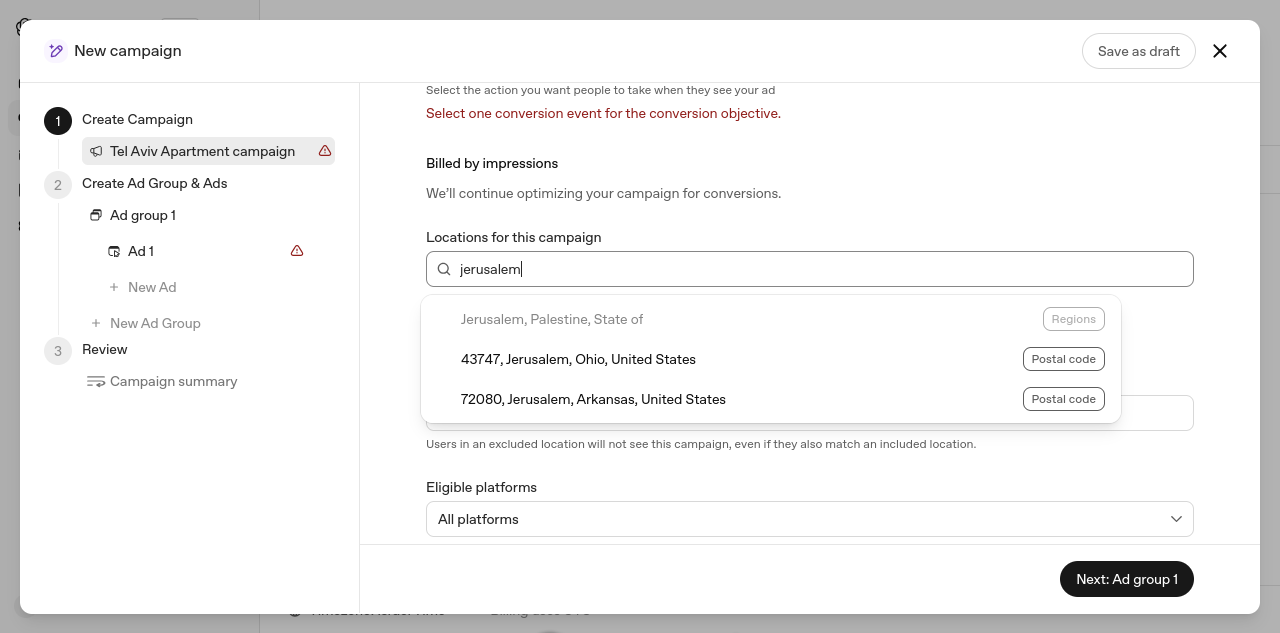
    Entering “Jerusalem” in the location field of a new campaign produces “Jerusalem, Palestine, State of”, listed as a region. Two American postcodes follow, for towns named Jerusalem in Ohio and Arkansas. No suggestion points to Jerusalem in Israel.

    Screenshot of OpenAI Ads Manager (beta), New campaign, locations field: typing "jerusalem" lists "Jerusalem, Palestine, State of" (Regions), then postal codes 43747 (Jerusalem, Ohio, United States) and 72080 (Jerusalem, Arkansas, United States). No suggestion for Jerusalem, Israel.
    Computer, 29 September 2026: “jerusalem” returns “Jerusalem, Palestine, State of”, then Ohio and Arkansas.

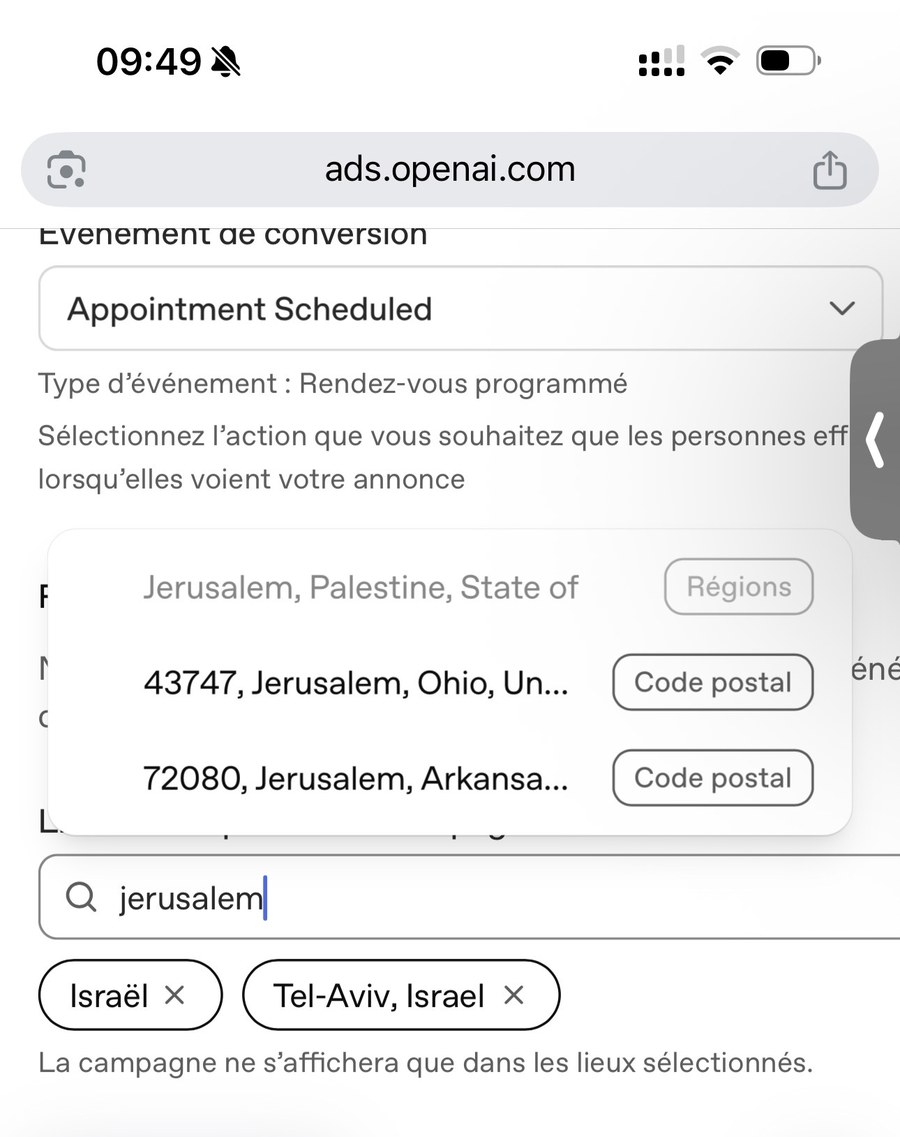
    The result is the same on a phone and on a computer.

    iPhone screenshot at 09:49 of OpenAI Ads Manager (beta) with the interface in French. "Israël" and "Tel-Aviv, Israel" are already selected. Typing "jerusalem" suggests "Jerusalem, Palestine, State of" (Régions), then postal codes 43747 (Jerusalem, Ohio) and 72080 (Jerusalem, Arkansas).
    Phone, 29 September 2026, 09:49 (interface in French): the same result.

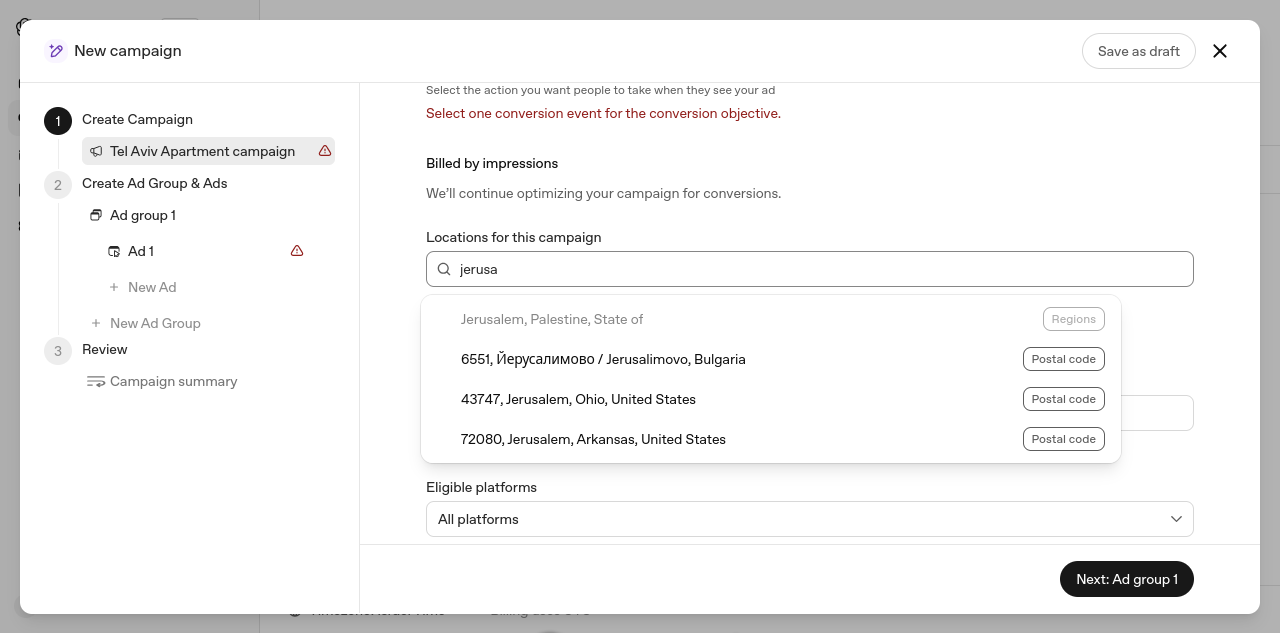
    Typing just “jerusa” already puts the Palestinian entry first. Adding the French accent, “jérusalem”, changes nothing on the computer.

    Screenshot of OpenAI Ads Manager (beta), New campaign, locations field: typing "jerusa" lists "Jerusalem, Palestine, State of" (Regions), then postal codes 6551 (Jerusalimovo, Bulgaria), 43747 (Jerusalem, Ohio, United States) and 72080 (Jerusalem, Arkansas, United States).
    “jerusa” already puts “Jerusalem, Palestine, State of” first.

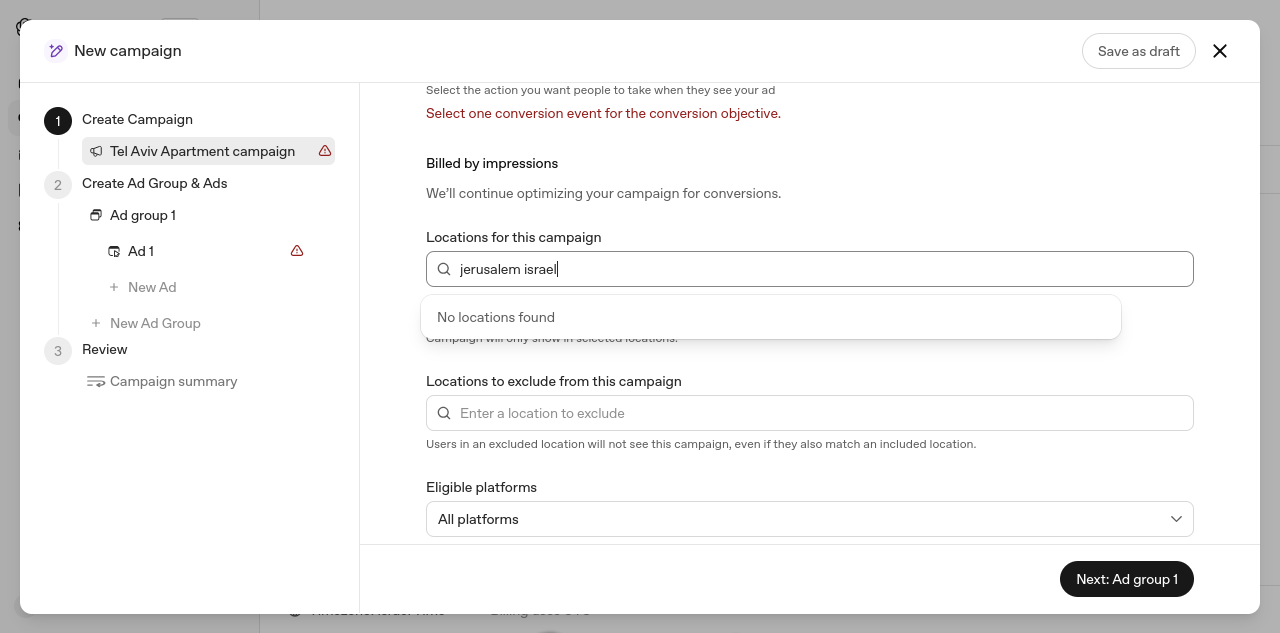
    Adding “israel” does not help: “jerusalem israel” returns “No locations found”. The Hebrew name of the city fares no better.

    Screenshot of OpenAI Ads Manager (beta), New campaign, locations field: typing "jerusalem israel" displays "No locations found".
    “jerusalem israel” returns “No locations found”.

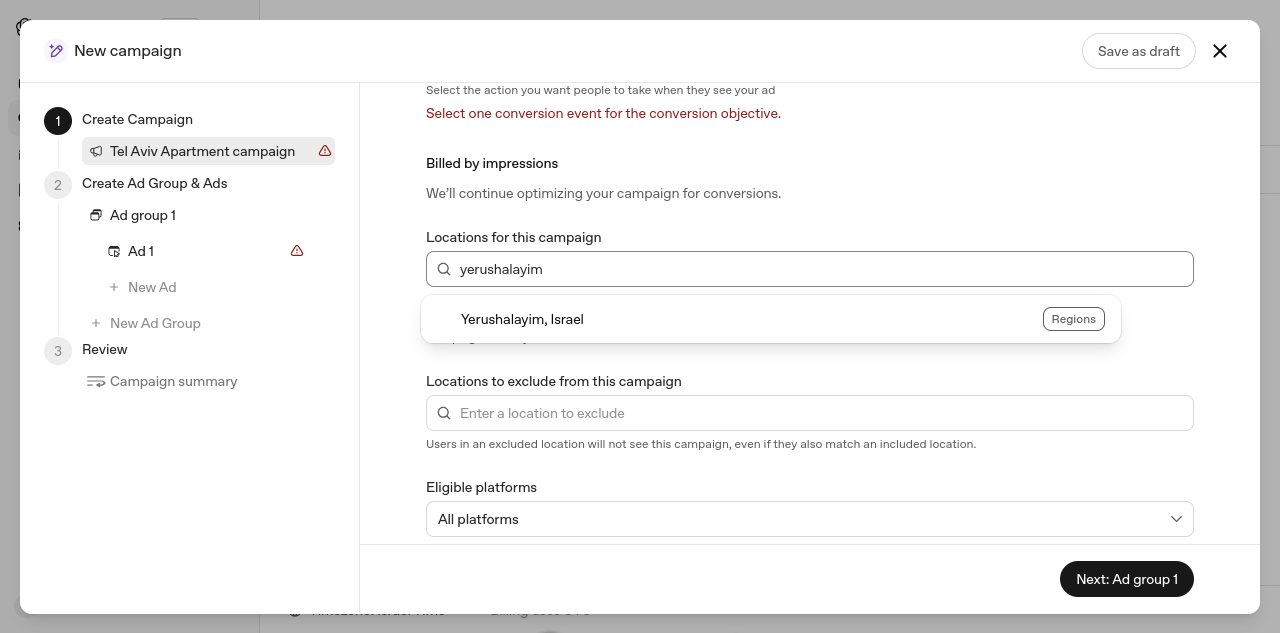
    The only route the testers found is the transliteration “Yerushalayim”, which returns “Yerushalayim, Israel”, a region that can be selected. The same entry also appears among the regions listed under Israel.

    Screenshot of OpenAI Ads Manager (beta), New campaign, locations field: typing "yerushalayim" displays "Yerushalayim, Israel" (Regions).
    The transliteration “yerushalayim” returns “Yerushalayim, Israel”.

    This is not a general failure affecting Israeli cities

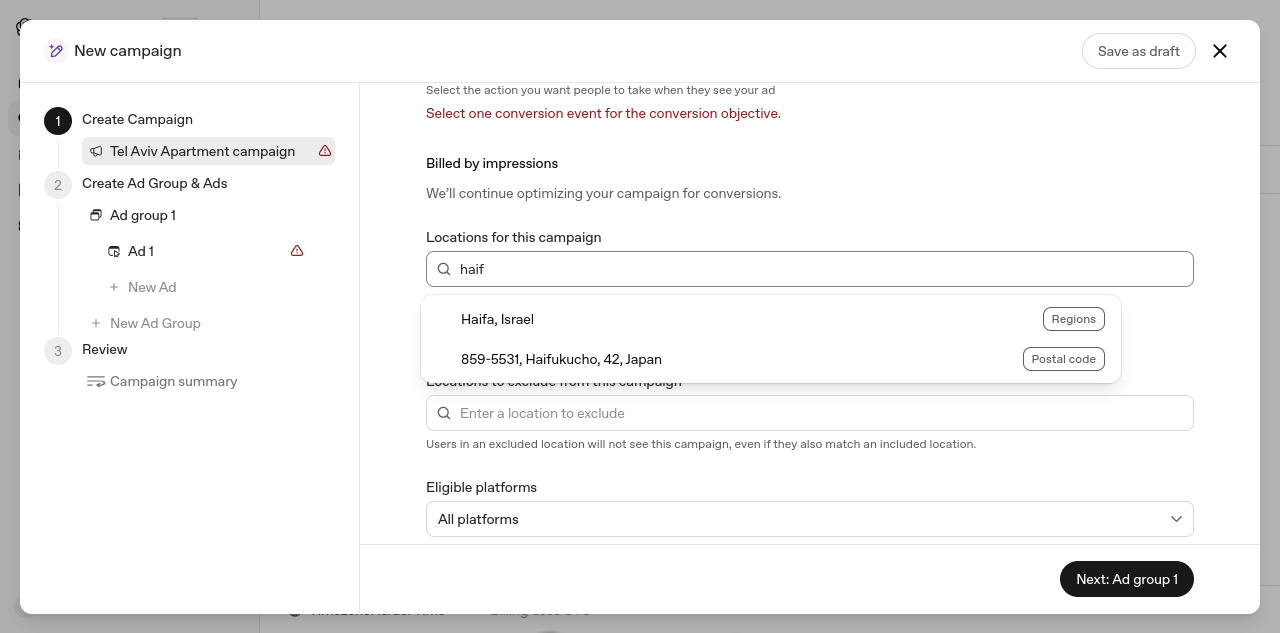
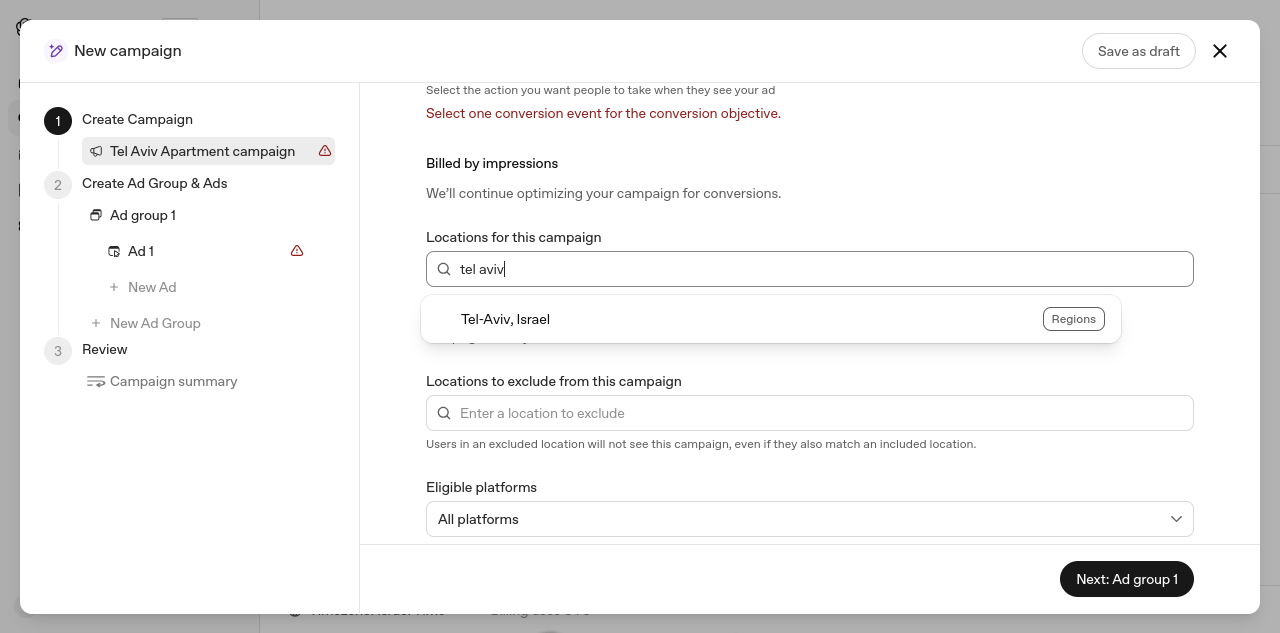
    Haifa and Tel Aviv appear in Israel under their usual names. “haif” offers “Haifa, Israel”; “tel aviv” offers “Tel-Aviv, Israel”. Of the Israeli cities tested, the capital is the one that cannot be found under its own name in Israel.

    Screenshot of OpenAI Ads Manager (beta), New campaign, locations field: typing "haif" lists "Haifa, Israel" (Regions), then a postal code in Japan (859-5531, Haifukucho).
    “haif” returns “Haifa, Israel”.
    Screenshot of OpenAI Ads Manager (beta), New campaign, locations field: typing "tel aviv" displays "Tel-Aviv, Israel" (Regions).
    “tel aviv” returns “Tel-Aviv, Israel”.

    Arabic names do not close the gap. “Al Quds”, “Al-Quds”, “Quds”, the Arabic spelling, “east jerusalem” and “jerusalem palestine” all return “No locations found”. The common name leads to Palestine; the other names lead nowhere.

    Postcodes do not fix it

    The testers also checked whether Jerusalem’s postcodes worked. The Israeli postcodes for Jerusalem that they tried, for example 9100000, return no location: “No locations found”.

    What this means for Israeli business in Jerusalem

    This is not an abstract quarrel over a name. Local advertising exists so that a business can reach the people who live near it. Israeli economic life in Jerusalem includes not only the Knesset, the President’s residence and the Supreme Court, but also neighbourhood shops, traders, start-ups and independent professionals.

    Under the common name “Jerusalem”, that activity cannot be targeted in this tool, because the name resolves to Palestine. The advertiser is left with two options. Either they know the Hebrew name in Latin letters, which many will not, or they select the whole of Israel. The tool states that a campaign is shown only in the chosen locations, so the advertisement then runs far beyond the advertiser’s own city. A clinic in Jerusalem faces a choice that a clinic in Haifa or Tel Aviv does not.

    In practice, these businesses are denied localised advertising under the name of their own city. No figure is offered here for the extent of that effect. The finding is precise: what the tool displayed on one day, in a beta version.

    The effect is visible on the screen. The tool does not treat Israeli city names in the same way: two of them appear under their usual names, while the capital appears under Palestine.

    What we ask

    Jerusalem is the capital of the State of Israel and the seat of the Knesset, the Supreme Court and the presidency. It is the city the Jewish people have never ceased to remember. A marketing tool that advertisers use to turn clicks into sales, visits and contracts should not make that name lead to Palestine.

    OpenAI should fix this: associate “Jerusalem” with Israel in Ads Manager, and respond publicly. The tool is in beta, and betas exist to be corrected.

    Mark Bambury, Head of EMEA Ads at OpenAI, was notified of this omission on 30 September 2026.

    Until then, an Israeli shopkeeper, a start-up founder or a doctor in Jerusalem who opens the tool and types the name of their own city will be sent to Palestine, then to Ohio and Arkansas, to promote their business. That is what the screen showed on 29 September 2026.

    Jerusalem is the capital of Israel, and the city that the Jewish people have never ceased to remember and where they have lived continuously since the First Temple.

  • Rehavia and Talbiyeh Church Lands: Supreme Court Ends KKL Case as Sub-Lessees Report Stalled Talks

    Rehavia and Talbiyeh Church Lands: Supreme Court Ends KKL Case as Sub-Lessees Report Stalled Talks

    By David Nataf
    26 September 2026 — Jerusalem

    Jerusalem — The legal and commercial uncertainty over the former Greek Orthodox Patriarchate lands in Rehavia, Talbiyeh and Nayot deepened this summer: on 16 July 2026 Israel’s Supreme Court refused to rehear a Patriarchate lease case brought by a subsidiary of the Jewish National Fund (KKL-JNF), while sub-lessees say talks over their apartments’ future have stalled. A district-court ruling reported on 20 August could, according to TheMarker, give some of them a new legal argument.

    Key facts

    • The land: about 500 dunams in Talbiyeh, Rehavia, Nayot and around Liberty Bell Park, with about 1,000 housing units, hotels and public institutions (Nadlan Center).
    • The leases: KKL-JNF leased the land from the Greek Orthodox Church in the early years of the state for up to about 99 years, ending around 2051–52; residents are sub-lessees of KKL-JNF.
    • Ownership: the Church sold the land in 2017 to a private group; in January 2023 the group sold it to Extel, controlled by US businessman Gary Barnett, for ₪750 million (Nadlan Center).
    • 16 July 2026: the Supreme Court rejected a KKL-JNF subsidiary’s request for a further hearing in a Patriarchate lease dispute; KKL-JNF will not receive the $13 million it sought (Globes).
    • Disputed claim: a sub-lessees’ forum says apartment values have fallen by 50% — a figure not independently verified.
    • 20 August 2026: TheMarker reported a Central District Court ruling on a Rehovot plot that could be invoked by Jerusalem sub-lessees.

    The Supreme Court ends one dispute

    On 16 July 2026, the Supreme Court rejected a request by a KKL-JNF subsidiary for a further hearing in a case over the extension of its lease on Patriarchate land, Globes reported. The decision leaves in place an earlier Supreme Court majority ruling that a detailed interim document, read out at a ceremony between the parties, was a stage in negotiations rather than a binding contract, because the requirements of writing, intent and specificity had not been met. As a result, KKL-JNF will not receive the $13 million it had sought, according to Globes.

    In the earlier ruling, Justice Ofer Grosskopf criticised the tendency of Israeli courts to treat interim documents as binding agreements. “We would do well to shift the direction of its movement and restore to Israeli contract law a certain measure of formalism,” he wrote, as quoted by Globes (translated from Hebrew). In rejecting the further hearing, the court said this was not a new legal rule that would justify one.

    Sub-lessees: “our values have fallen by 50%”

    More than 100 sub-lessees say that talks to settle their rights with Extel have made no progress since a change of management at KKL-JNF at the start of 2026, when Eyal Ostrinsky became chairman, Nadlan Center reported on 24 July. According to the residents, the uncertainty makes apartments hard to sell or mortgage and holds up urban-renewal projects, while the leases expire around 2050.

    “The value of our apartments has plummeted by 50%,” said Doron Shmueli, a lawyer who chairs the forum of Jerusalem KKL-JNF land lessees, quoted by Nadlan Center. The figure is his; it has not been independently verified, no transaction data supporting it was published, and neither KKL-JNF nor Extel has endorsed it. Shmueli said a direct negotiation between residents and the landowner had produced “a balanced offer” and called on KKL-JNF and the Jerusalem Municipality to join the talks.

    Residents are divided. About 200 sub-lessees have petitioned the High Court of Justice to have the leases extended, Nadlan Center reported; in September 2025 the Supreme Court declined to freeze talks between KKL-JNF and Extel but ordered KKL-JNF to hold a public hearing and share the details of any agreement with sub-lessees before signing. Others are pursuing agreements with Extel: more than 150 families have signed documents to advance arrangements, according to Nadlan Center, under outlines that would offer full ownership of new apartments after pinui-binui redevelopment, or a long-term lease extension.

    People close to Extel told Nadlan Center that “more and more residents are joining the move to secure their rights” and that “the ball is now mainly in the court of KKL-JNF and the Jerusalem Municipality.” KKL-JNF said it has held and is holding meetings with the company that acquired the land and with others “in an attempt to reach a comprehensive arrangement, while caring for the rights of the residents,” noted that proceedings are pending before the Supreme Court, and said that “significant decisions will be made in the near future.”

    A Rehovot ruling with possible Jerusalem implications

    In a separate case, the Central District Court in Lod ruled that a family holding a 1.8-dunam former orchard in Rehovot has “a leasehold right with exceptional and special aspects,” because of a transaction made with KKL-JNF in the 1950s, TheMarker reported on 20 August 2026. According to TheMarker, the ruling could be used by owners of about 1,000 apartments, public institutions and hotels in Jerusalem who are sub-lessees of KKL-JNF on the land it leases from Extel. The ruling concerns a different property; whether it would apply to the Jerusalem leases has not been tested in court.

    Why it matters for the market

    The affected streets are among Jerusalem’s most expensive. Closed-deal medians compiled by TAA from Tax Authority records put Rehavia at about ₪48,300 per square metre and Talbiyeh at about ₪42,100, with wide gaps between sources for both neighborhoods — see our Jerusalem sale prices by neighborhood. Those figures do not separate apartments on former Patriarchate land from others, so they cannot confirm or refute the sub-lessees’ claim.

    Related: Jerusalem sale prices by neighborhood · Jerusalem hub

    Sources

    1. Globes — The Greek Patriarchate and the Jerusalem lands: there will be no further hearing (Jennifer Sylon, 16 July 2026, Hebrew)
    2. Nadlan Center — “Apartment values plummeted 50%”: church-land lessees in Jerusalem accuse KKL (Dror Nir Kastel, 24 July 2026, Hebrew)
    3. TheMarker — Precedent-setting ruling on a Rehovot orchard could shake land ownership in the heart of Jerusalem (Simi Spolter, 20 Aug. 2026, Hebrew)

  • Jerusalem Approves Hasbon Compound Plan: About 950 Homes and Three 41–43-Storey Towers

    Jerusalem Approves Hasbon Compound Plan: About 950 Homes and Three 41–43-Storey Towers

    By David Nataf
    26 September 2026 — Jerusalem

    Jerusalem — The Jerusalem District Planning and Building Committee approved on 6 September 2026 the urban-renewal plan for the Hasbon compound in the city centre: about 950 housing units, including some 200 rental apartments, in three towers of 41 to 43 storeys and lower buildings around King George, Hillel and Meir Shaham streets. The 27-dunam site lies next to the approved route of the light rail’s Blue Line, according to reports by ice.co.il, Nadlan Center and Magdilim.

    Key facts

    • Decision: approved by the Jerusalem District Planning and Building Committee on 6 September 2026, after hearing objections.
    • Site: about 27 dunams between King George, Hillel and Meir Shaham streets and Sherman Park, beside the approved Blue Line.
    • Housing: about 950 units, of which about 200 are for rent for 15 years; 96 existing units to be demolished.
    • Height: three towers of 41–43 storeys, plus lower buildings.
    • Other uses: about 4,600 m² of hotel space, 14,000 m² of commerce and employment, 7,200 m² of public uses and 4,500 m² of student housing.
    • Planners: MVRDV (Netherlands) with GEHL (Denmark); the plan was submitted by Even Israel Ltd.

    What the plan includes

    The compound currently contains commercial, office and residential buildings, with several important historic buildings at its centre known as the “Anton Hasbon compound.” Much of the site has served for years as a kind of “backyard” of the city centre, with open-air parking and areas closed to the public, ice.co.il and Nadlan Center reported.

    The plan combines the renewal of some existing residential buildings with an intensive urban block: three towers of 41 to 43 storeys alongside lower-rise buildings, mixing housing, commerce, employment and hotels. It provides for about 950 housing units, of which about 200 are designated as rental housing for 15 years, about 4,600 m² of hotel space, about 14,000 m² for commerce and employment, and about 7,200 m² for public uses, including a public library, an indoor sports hall and kindergartens. Ninety-six existing housing units, along with older commercial and office buildings, are to be demolished.

    The historic buildings are to be preserved and integrated into hotel uses around a large public square at the heart of the block, connected to the surrounding streets by pedestrian passages, alleys and courtyards, according to the District Committee. The plan also includes the redevelopment of Sherman Park.

    Changes after the objections

    The plan was approved for deposit in May 2025, which opened the objection process, Magdilim reported. After hearing the objections, the committee added 4,500 m² of student housing and decided to preserve the “Beit Pygmalion” building at the corner of King George and Meir Shaham streets, designed by architect Otto Hoffmann in the 1950s. The reports did not detail who filed the objections.

    “This is an important plan that continues the momentum of renewal in Jerusalem’s central business district and offers architectural and design excellence, giving a new interpretation to the historic fabric of the city centre,” said Dan Kinan, the Jerusalem district planner at the Planning Administration, as quoted by ice.co.il and Nadlan Center (translated from Hebrew). He said the plan would create “a significant centre of gravity” for culture, commerce, employment, hotels and housing, alongside student dormitories and rental housing, “relying on an efficient public-transport system.”

    Built around the Blue Line

    The compound sits next to the approved route of the Blue Line, which is planned to run 24 kilometres from Ramot in the north to Gilo in the south through downtown Jerusalem, with 40 stations. The Jerusalem Post reported on 29 August 2026 that the line is not projected to open before 2029 or 2030. At the Globes Israel Real Estate Conference on 7 September, City Engineer Yoel Even said taller construction is concentrated in urban-renewal areas and employment hubs where it can rely on mass-transit systems.

    District approval is a planning milestone, not the start of construction. Building permits, financing, agreements with existing owners and tenants, and the demolition of existing buildings would still be required, and no construction timetable was given in the reports. The figures above are those published at approval; final numbers could change at the permit stage.

    Related: Jerusalem tops 7,000 housing permits for a fifth year · Green Line opens its first leg · Jerusalem hub

    Sources

    1. ice.co.il — The giant urban-renewal plan: 950 new apartments, 200 for rent (Itzik Yitzhaki, 6 Sept. 2026, Hebrew)
    2. Nadlan Center — Three towers of more than 40 storeys in the heart of Jerusalem: Hasbon compound plan approved (6 Sept. 2026, Hebrew)
    3. Magdilim — After the objections: the changes in Jerusalem’s Hasbon compound (7 Sept. 2026, Hebrew)
    4. The Jerusalem Post — Jerusalem light rail expands with new L3 route (Shir Perets, 29 Aug. 2026)
    5. Globes — Jerusalem city engineer at the Israel Real Estate Conference (Nevo Shapir, 7 Sept. 2026, Hebrew)

  • Old City Apartment Facing the Western Wall Listed at ₪50 Million Asking Price; No Sale Reported

    Old City Apartment Facing the Western Wall Listed at ₪50 Million Asking Price; No Sale Reported

    By David Nataf
    26 September 2026 — Jerusalem

    Jerusalem — A 240-square-metre apartment in the Old City’s Jewish Quarter, designed by architect Moshe Safdie and overlooking the Western Wall, has been put up for sale with an asking price of about ₪50 million, TheMarker reported on 31 August 2026. The figure is an asking price, not a completed sale: no buyer has been reported. Earlier attempts to sell the property at close to ₪100 million did not lead to a deal, according to the report.

    Key facts

    • What: a 240 m² apartment facing the Western Wall plaza, designed by Moshe Safdie, built in 1973 (TheMarker).
    • Status: offered for sale at about ₪50 million — an asking price; no transaction has been reported.
    • Per square metre: about ₪208,000/m² at the asking price (Emess calculation).
    • Previous attempts: marketed in recent years at close to ₪100 million, without a sale (TheMarker; Emess).
    • Recent closed deals nearby, outside the walls: ₪66.3 million for 510 m² in Kfar David, March 2026 (Globes); about ₪100 million before VAT for some 800 m² in Mamilla, completed end of March 2026 (TheMarker).

    The listing

    According to TheMarker, the apartment is in one of the buildings erected near the Western Wall plaza after 1967. It was designed by Safdie, completed in 1973 and bought five years later by a Jewish soldier serving with the US Army in Jerusalem, who paid what the paper described as “hundreds of thousands of dollars.” The Western Wall can be seen from all of its windows, the report said.

    The owner, now 91, has decided to sell and pass the proceeds on to the next generations of his family, the Haredi news site Emess reported on the same day, citing TheMarker. At ₪50 million, the asking price works out at roughly ₪208,000 per square metre, Emess calculated. A listing article published on 30 August by the site HaMechadesh, marked as sponsored content, said the apartment had been advertised on the commercial real-estate listings site Menivim at the same price.

    An asking price reflects what a seller hopes to obtain. Whether a buyer will pay it — or how far the price might move in negotiation — is not known. The owner’s earlier attempts at close to ₪100 million did not produce a deal.

    What recent sales near the Old City show

    Closed transactions reported in the Israeli press this year were concluded just outside the Old City walls, in the Mamilla area, rather than inside the Jewish Quarter:

    • Kfar David (March 2026). Developers Damri and Bumel Israel sold a 510 m² apartment with a 60 m² balcony, an attached roof and an open view of the Old City walls for ₪66.3 million, and a second, 386 m² apartment in the same building — without the wall view — to the same buyer for ₪25 million, Globes reported on 15 April 2026. Both were sold as bare shells. Prices in the project ranged from about ₪54,000 to ₪120,000 per square metre, with the floor, and therefore the view of the walls, the main factor, according to Globes; most buyers in the project were wealthy foreign residents.
    • Mamilla (end of March 2026). Alrov Real Estate and Hotels completed the sale of a shell space of about 800 m² in the Mamilla complex overlooking the Old City walls and the Temple Mount, TheMarker reported on 20 May 2026. The price was about ₪100 million before VAT, according to TheMarker’s report as cited by other Israeli outlets; it was described as the last apartment sold in the project.

    On those figures, the Kfar David and Mamilla deals were concluded well below the per-square-metre level implied by the Jewish Quarter asking price. Emess wrote that exceptionally luxurious properties in Jerusalem “may sell” at around ₪100,000–150,000 per square metre, depending on location and specification. The comparison has limits: the Old City listing is a finished, decades-old apartment inside the walls, while the Mamilla and Kfar David units were new shells outside them.

    A thin and unusual market

    Private apartments with a direct view of the Western Wall rarely come onto the open market, and publicly reported transactions inside the Old City are few, which makes any single price difficult to benchmark. The Old City lies in East Jerusalem, which Israel captured from Jordan in 1967 and later annexed; the annexation is not recognised by most of the international community, and Palestinians seek East Jerusalem as the capital of a future state. The status of property in the Old City is politically sensitive and has been the subject of legal disputes.

    Related: Jerusalem sale prices by neighborhood · Jerusalem hub

    Sources

    1. TheMarker — At 91 he decided to sell and cut the price: the rare apartment facing the Western Wall is offered for ₪50 million (Simi Spolter, 31 Aug. 2026, Hebrew)
    2. Emess — Who will pay ₪50 million to wake up facing the Western Wall (Gadi Fuchs, 31 Aug. 2026, Hebrew)
    3. HaMechadesh — Apartment facing the Western Wall offered for ₪50 million (30 Aug. 2026, Hebrew; marked as sponsored content)
    4. Globes — More than ₪90 million: the unusual real-estate deal facing Jerusalem’s walls (Arik Mirovsky, 15 Apr. 2026, Hebrew)
    5. TheMarker — Akirov sold an 800 m² apartment in Mamilla for ₪100 million (20 May 2026, Hebrew)

  • Jerusalem’s Green Line Opens Its First Leg, HaTurim–Malha; Gilo Section Due in December

    Jerusalem’s Green Line Opens Its First Leg, HaTurim–Malha; Gilo Section Due in December

    By David Nataf
    26 September 2026 — Jerusalem

    Jerusalem — Five weeks after it opened, the first section of Jerusalem’s Green Line — designated L3 — runs about 7 kilometres from HaTurim, near the Mahane Yehuda market, to Malha in the south of the city, with 13 stations, 12 of them new, and trains every eight minutes at peak times, The Jerusalem Post reported when service began on 21 August 2026. The next section, L4 from the Central Bus Station to Gilo, is scheduled for December.

    The route

    From HaTurim, L3 runs west past the Central Bus Station and the Yitzhak Navon railway station, then south to the Knesset and government complex, the International Convention Center, the Hebrew University’s Givat Ram campus and the Botanical Gardens, before stopping at Teddy Stadium and the Pais Arena and ending near Malha Mall and the Gav Yam technology park. It serves the Givat Mordechai, Pat, Gonenim and Malha neighborhoods.

    L3 connects with the Red Line (L1) at two transfer points — HaTurim, and the Central Bus Station / International Convention Center stop behind Navon station — creating what Mayor Moshe Lion called a network rather than a single line. “Jerusalem is moving from a city that has a light rail to a city with a light rail network,” he said. Like the rest of the system, the new line does not run on Shabbat.

    The Red Line, open since 2011 and extended in recent years between Neve Yaakov and Hadassah Ein Kerem, carries about 200,000 riders a day, according to the Post; the full light-rail system could eventually carry up to 400,000 a day.

    What comes next

    • December 2026 — L4, Central Bus Station to Gilo. Gilo is the city’s largest neighborhood, with more than 100,000 residents, and the line is expected to give them faster access to Givat Ram and Navon station.
    • June 2027 — Mount Scopus. The route is scheduled to reach the Hebrew University’s Mount Scopus campus through French Hill and the area near the Israel Police national headquarters, linking the university’s two campuses by rail.
    • End of 2027 — Givat Shaul and Har Nof branch.
    • Blue Line. Already under construction, it is planned to run 24 kilometres from Ramot in the north to Gilo in the south through downtown Jerusalem and Har Hotzvim, with 40 stations. The Post reported on 29 August that it is not projected to open before 2029 or 2030.

    The Green Line is years behind its original schedule. Citing Globes, the Post reported that L3 opened ten years later than planned, when earlier projections had the whole line completed by 2025; the rounds of fighting with Iran added further delays. Residents along the route, including in Givat Mordechai, Pat and on Jaffa Road, lived with years of works and detours.

    Rail and the housing map

    Rail is also shaping where the city plans to add homes. At the Globes Israel Real Estate Conference on 7 September, City Engineer Yoel Even said taller construction is concentrated in urban-renewal areas and employment hubs, including the city entrance, where it can rely on mass-transit systems, while historic neighborhoods keep lower-rise rules.

    Heavy rail is part of the picture too. The Benin complex — about 10 dunams between Jaffa Road, HaNevi’im Street and Raoul Wallenberg Street — was put up for sale with a starting price of NIS 420 million, Calcalist’s CTech reported on 1 September. Its approved plan allows two residential towers of 29 and 31 storeys with 295 apartments, hotels with about 200 rooms and commercial space. It includes a station on the planned extension of the railway line from Yitzhak Navon station into the city centre and eventually to Khan station; construction work on the station has begun, and bids are due by 3 December.

    Near the New Talpiot project, Globes reported in February that tall towers have been approved along Hebron Road because the light rail will run past there; appraiser Kobi Bir told the paper he expected the area to “change completely” within ten years.

    Related: Jerusalem rent prices by neighborhood · Jerusalem hub

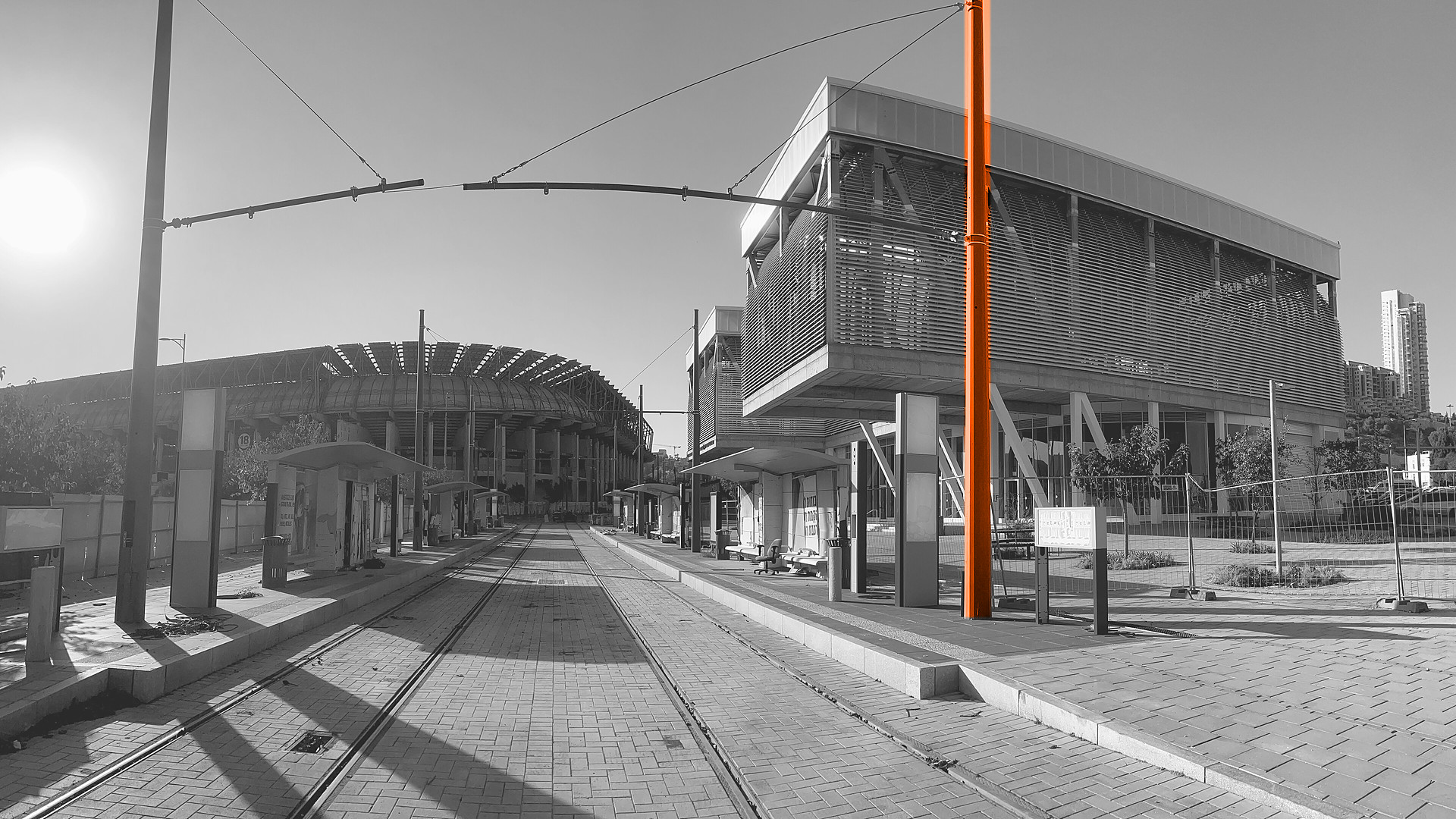
    Featured image: Sports Complex Malha light-rail station, Jerusalem, photographed in November 2025. Photo: Adielbm, CC BY-SA 4.0, via Wikimedia Commons. Converted to black and white with one orange accent by Tel Aviv Apartment; the adapted image is shared under the same licence.

    Sources

    1. The Jerusalem Post — Jerusalem launches second light rail line after Iran war delays (Udi Ezion, Efrat Forsher; 19 Aug. 2026, updated 21 Aug. 2026)
    2. The Jerusalem Post — Jerusalem light rail expands with new L3 route (Shir Perets, 29 Aug. 2026)
    3. CTech by Calcalist — 10 dunams in central Jerusalem hit the market for $140 million (1 Sept. 2026)
    4. Globes — Jerusalem city engineer at the Israel Real Estate Conference (Nevo Shapir, 7 Sept. 2026, Hebrew)
    5. Globes — Foreign resident buys seven Jerusalem apartments (Arik Mirovsky, 22 Feb. 2026)

EN|FR