האחדות
The Unity
Shchunat Ezrat Yisrael, Yerushalayim · Since 1910
Tel Aviv Apartment

Tel Aviv Apartment

Author: David Nataf

  • Could October 7 Have Been Prevented?

    Could October 7 Have Been Prevented?

    Jericho Wall, the ignored warnings, and the competing theses

    This week’s argument in Israel — a Haaretz investigation into an Emirati warning to Benjamin Netanyahu, a Ronen Bergman piece in Yedioth Ahronoth on a secret channel with Hamas, and a libel suit announced by the prime minister — is not about a footnote. It is about an older question: was 7 October 2023 a surprise that could not have been seen, or the product of a refusal to listen?

    Documented facts and competing theses must be kept apart.

    1. The central document: “Jericho Wall”

    The reference text remains the investigation by Ronen Bergman and Adam Goldman, published on 30 November 2023 in The New York Times:

    https://www.nytimes.com/2023/11/30/world/middleeast/israel-hamas-attack-intelligence.html

    What that article established, and what later IDF internal inquiries confirmed:

    • In 2022, Israeli military intelligence obtained an approximately 40-page Hamas document, the latest version of a plan developed since the early 2010s. Israelis code-named it “Jericho Wall.”
    • The document opens with a Quranic verse: “Surprise them through the gate. If you do, you will certainly prevail.”
    • The plan describes, in order: a rocket barrage to drive soldiers into shelters; drones against cameras and automated machine guns on the fence; a breakthrough at dozens of points (the document speaks of about sixty); an assault by paraglider, motorcycle and on foot; the overrun of the Gaza Division and bases including Re’im; attacks on kibbutzim.
    • Hamas had gathered highly precise intelligence on the Israeli deployment: locations, force sizes, communication hubs.

    On 7 October, Hamas executed the plan “with shocking precision.” Every building block in the document appears in the actual attack.

    What the document was not: a date. Jericho Wall is a method of attack, not a calendar.

    What was done with it: the Gaza Division treated it as a “compass” — Hamas knew where it wanted to go but had not arrived. Officers including Military Intelligence chief Aharon Haliva, Southern Command chief Eliezer Toledano and Yaron Finkelman judged the plan unrealistic. A Gaza Division colonel in July 2023 called the scenario “totally imaginative.”

    It is not established that Netanyahu personally read Jericho Wall. The Times wrote that the document circulated widely among senior military and intelligence leaders; transmission to the political top is unproven.

    2. The one who listened: the Unit 8200 analyst

    On 6 July 2023, a veteran Unit 8200 analyst wrote to colleagues. Hamas had just run a day-long exercise under the eyes of senior commanders: a dry run of shooting down Israeli aircraft, taking a kibbutz, overrunning a training base, killing the cadets. During the drill, Hamas fighters used the same Quranic verse that opens Jericho Wall.

    She wrote, in emails reviewed by the Times:

    “I utterly refute that the scenario is imaginary. […] It is a plan designed to start a war, not just a raid on a village. We already had a similar experience fifty years ago on the southern front regarding a scenario that seemed imaginary. History could repeat itself if we are not careful.”

    An explicit reference to Yom Kippur 1973. A Gaza Division colonel held the line: imaginary scenario. His view prevailed.

    The female field observers at Nahal Oz had, for months, reported abnormal activity along the fence. The IDF meta-investigation (Turgeman committee, 2025) said their intelligence, properly analysed, could have exposed Hamas’s unusual activity. It was not treated as such.

    3. The other documented warnings

    Shin Bet, September 2023. A Fatah intermediary meets Sinwar in Gaza. Sinwar speaks of a “huge surprise,” repeats the Arabic word zilzal (earthquake), asks that the message be passed to the Israelis. The message reaches the Shin Bet around 15 September. Ronen Bar briefs Netanyahu. A security meeting follows. The dominant reading: West Bank tension — not an invasion from Gaza.

    Egypt. General warnings of the “make the ground tremble in Gaza” type, without a date or method.

    The night of 6–7 October. Aman flags unusual activity in Hamas’s aerial array. A raid is discussed as a possibility. To avoid burning sources, and because of signs read as reassuring, Southern Command and the General Staff take only minor steps and schedule an update for 8:30 a.m. The attack begins around 6:30 a.m.

    Bergman has shown that from 2:00 a.m., the prime minister’s intelligence officer received the material through two channels and woke up to read it. The claim that “they decided not to wake him” is, on this specific point, contradicted by that timeline.

    Aman letter of 23 July 2023 (Bergman, Ynet, 10 September 2026). Brigadier General Amit Sa’ar sends Netanyahu the most severe warning letter of that period. It quotes a clandestine channel with Hamas, code-named “Srogim”: Sinwar’s messages pass through the brother of a Hamas official.

    Quoted in the letter:

    “There are multiple explosive fuses. The extremists in your government are leading you to light them and set the entire region on fire, and you alone will bear responsibility for the consequences.”

    Netanyahu says the warnings he received before the massacre concerned only Hezbollah and Iran. Bergman writes that this is false: this letter explicitly cites a Hamas channel.

    Article: https://www.ynet.co.il/news/article/rjispaaugl

    4. The Haaretz investigation (8 September 2026)

    This is not Bergman. Authors: Shlomi Eldar and Ruth Yuval, for the book Hostages: 843 Days of Abandonment.

    Core allegation. In late September 2023, about ten days before the massacre, Mohammed bin Zayed calls Netanyahu from Abu Dhabi. Forty-five minutes. MBZ warns that Sinwar is preparing a major operation. Netanyahu reacts calmly, talks more about the West Bank, does not pass the warning to Halevi or Bar. Both men have said they were never informed of such a call.

    What supports the story without proving the call itself: – A senior Middle East intelligence official confirms to Ynet that the UAE passed Israel, shortly before 7 October, a warning from a “very reliable” source about a “significant and imminent” Hamas action. He does not confirm that it was a personal MBZ–Netanyahu call. – The UAE refuses the categorical denial requested by the Prime Minister’s Office. Its statement: channels exist; relevant intelligence “has been and continues to be communicated.” – Naftali Bennett says the report “is true,” without producing a document. – Eldar says he has documents and records. Nothing is public.

    Netanyahu’s denial. No call between early September and 7 October. Call logs, the National Security Council and the military secretariat were checked. MBZ calls go through an encrypted device brought to the PMO; entries are logged; there is no trace. A libel suit has been announced.

    State of the facts. That an Emirati warning reached Israel is highly probable. That it took the form of a 45-minute personal call to Netanyahu, followed by a deliberate withholding, is not established by a public official document.

    5. What official inquiries say

    As of September 2026 there is still no independent state commission of inquiry. There are IDF internal probes, a Shin Bet inquiry, and the Turgeman meta-investigation.

    Turgeman’s six causes (2025): a conceptual failure on Hamas’s intentions; an intelligence failure in assessment and warning; neglect of the defensive plan linked to Jericho Wall; a degraded organisational culture; a gap between the defined threat and the actual force posture; deficient decisions on the night of the attack.

    Committee quote: “The surprise of Oct. 7 did not emerge from a vacuum. On the night of Oct. 7, direct intelligence had accumulated which, if professionally analyzed, could and should have led to an alert and a significant operational response.”

    The Shin Bet (declassified summary, March 2025) accepts its failure. It adds that government policy allowed Hamas to accumulate weapons and funds (Qatari money diverted to the military wing). Ronen Bar said the attack could have been prevented.

    Military report: 767 soldiers on the border facing more than 5,000 attackers. Command collapse. Villages left on their own for hours.

    6. Four theses in the field

    Thesis A — The failure is first military and intelligence.
    The “conception” (Hamas is deterred, it governs, it does not want war) blinded Aman, the Shin Bet and the General Staff. The signals existed; the mental frame invalidated them. This is Bergman’s thesis, that of the IDF/Shin Bet inquiries, and the structural analogy with 1973. It is the best documented.

    Thesis B — The failure is first political.
    The “money for quiet” doctrine, the choice to treat Hamas as a useful manager against the Palestinian Authority, the refusal of a pre-emptive strike on Sinwar, the thinning of the south, the 2023 domestic crisis: all of that was set at the top. An independent civilian commission (2024) said the disaster “was not fate.”

    Thesis C — Netanyahu was not informed that night.
    The prime minister’s current line: had he been woken, he would have put the entire army on alert. This thesis runs into two facts: the PM’s intelligence officer received the material from 2:00 a.m.; and the chiefs who would have called him also believed any action would be limited.

    Thesis D — The Emirati warning changes the nature of the fault.
    If MBZ personally warned Netanyahu and Netanyahu passed nothing on, collective blindness becomes individual withholding of critical information. This is the Haaretz/Bennett thesis. It is politically explosive six weeks before elections. It is not yet proven in the documentary sense.

    7. Could October 7 have been prevented?

    Prevent any Hamas attack, someday? No one can guarantee that. Hamas had prepared the operation for years and also misled some of its allies on timing.

    Prevent this massacre — thousands crossing the fence essentially unopposed for hours, collapse of the Gaza Division, 1,200 dead, 250 hostages? Yes, in large part. Military inquiries say so. The signals were sufficient, in July and on the night of 6–7 October, to raise the alert level and cut the scale dramatically.

    What was missing was not information. It was permission to believe it.

    Knowing how to listen did not mean collecting warnings. Israel already knew how to do that. It meant letting a Unit 8200 analyst, a Nahal Oz observer or an Aman letter destroy the story the system told itself: Hamas is a manageable problem, the fence replaces soldiers, Sinwar is a pragmatist, quiet can be bought.

    Everything that said otherwise was filed as noise.

    Sources

    1. Ronen Bergman, Adam Goldman, “Israel Knew Hamas’s Attack Plan Over a Year Ago,” The New York Times, 30 November 2023. https://www.nytimes.com/2023/11/30/world/middleeast/israel-hamas-attack-intelligence.html
    2. Ronen Bergman, Ynet / Yedioth Ahronoth, 10 September 2026. https://www.ynet.co.il/news/article/rjispaaugl
    3. Shlomi Eldar, Ruth Yuval, Haaretz investigation / book Hostages: 843 Days of Abandonment, 8 September 2026.
    4. Turgeman committee, IDF meta-investigation, November 2025.
    5. Declassified Shin Bet inquiry summary, March 2025.
    6. Aman internal probe / Times of Israel, February 2025, on the handling of Jericho Wall.

    The established facts fit in one sentence: the plan was known, people said so, the system chose not to believe them. The rest — who knew what, at what hour, and who decided to stay silent — is still a political battlefield, in the absence of a state commission of inquiry.
  • A Proclamation, Not an Embargo: The Law Behind the September 8 Declaration on Settlement Trade

    A Proclamation, Not an Embargo: The Law Behind the September 8 Declaration on Settlement Trade

    Editorial · Geopolitics & Law · 9 September 2026

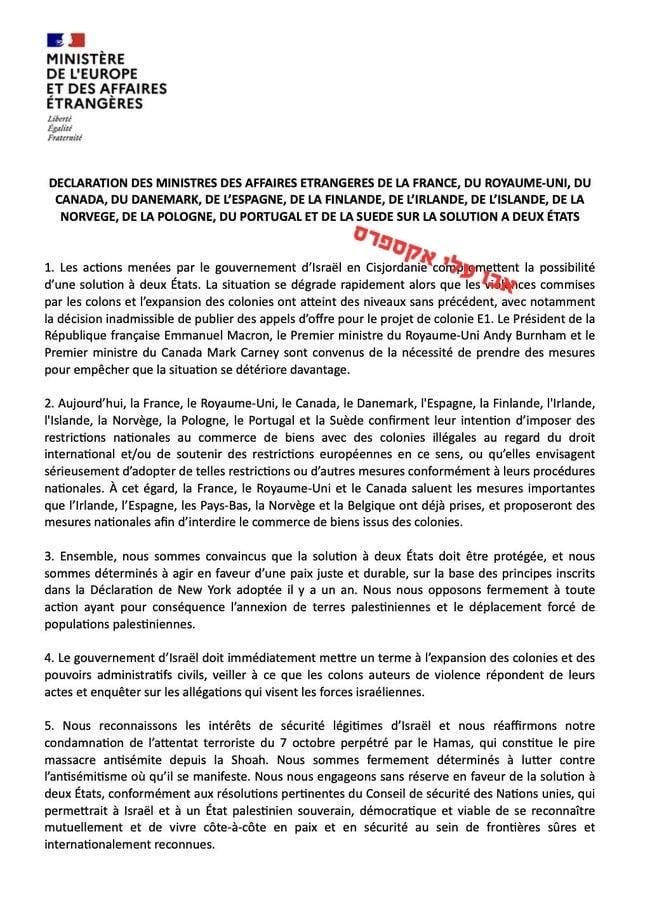
    On 8 September 2026, France’s foreign ministry released a joint statement by twelve foreign ministers, backed by a parallel declaration from three heads of government — Emmanuel Macron, British Prime Minister Andy Burnham and Canadian Prime Minister Mark Carney. It announces an intention: to restrict, nationally or at EU level, trade in goods produced in Israeli settlements, “in accordance with national procedures.” Everything legal turns on the gap — carefully preserved — between a communiqué and a norm. And it is precisely in that gap that the declaration reveals its weakness: it borrows the solemnity of law without accepting law’s constraints.

    What the text is — and is not

    It does not bind the European Union as such. It does not repeal the 1995 EU–Israel Association Agreement. It creates no obligation for economic operators. It does not bind parliaments. Its only immediate force is diplomatic: to align capitals, prepare public opinion, and present the Commission and the legislatures with a political fait accompli.

    That is not a defect of form; it is how diplomacy ordinarily works. But it dictates method. One does not test the lawfulness of a press release the way one would test an embargo. Three questions must be separated — questions the text skilfully blends into one: (1) the freedom to publish it; (2) whether the international-law thesis it asserts is sound; (3) whether the measures it promises comply with EU law and domestic law. At each descending level — from words toward binding constraint — the foundation thins.

    The illegality thesis and the trade ban are two claims, not one

    The text asserts that the settlements are “illegal under international law” and that trade with them may therefore be restricted. Two propositions, presented as a single deduction. They are not.

    The first — illegality — is the majority position in UN bodies. It rests on Article 49(6) of the Fourth Geneva Convention, the ICJ’s 2004 Wall advisory opinion, Security Council Resolution 2334 (2016), and, since 19 July 2024, the ICJ advisory opinion holding Israel’s continued presence in the occupied territory unlawful, calling on states not to recognise the situation as lawful or “render aid or assistance” in maintaining it, and to distinguish, in their dealings with Israel, between its territory and the occupied territory.

    Three truths the communiqué glosses over.

    First, an advisory opinion is not a judgment. It carries no res judicata against Israel, which was not party to a contentious case and did not consent to the Court’s jurisdiction over this dispute. It has moral and doctrinal weight; it does not command. Building an import ban on an advisory opinion confuses persuasive authority with binding force.

    Second — and this is the argument to meet head-on rather than dodge — the 2024 opinion did not merely say “distinguish.” It articulated a third-state duty of non-recognition and non-assistance, and it referred to economic dealings capable of entrenching the unlawful presence. Grant all of that. Three limits remain decisive. The Court prescribed no import ban: it did not convert a state’s duty of non-assistance into an obligation to sever private commerce. The duty of non-assistance targets aid in maintaining an unlawful situation — a doctrine of state responsibility built for inter-state conduct (recognition, treaties, official cooperation), not for a Belgian consumer buying a bottle of wine. Carrying an erga omnes obligation down to the supermarket till is a leap the Court never made. And if the duty truly reached that far, it would apply identically to every occupation the law condemns — Northern Cyprus, Western Sahara, Crimea, Tibet. None of the twelve signatories bans goods from those. A legal obligation that activates against one state only is not a legal obligation; it is a policy dressed as law.

    Third, Israel’s own thesis is not void. It holds that Article 49 targets forcible population transfers, not voluntary settlement; that the West Bank had no legitimate sovereign in 1967 (the Jordanian occupation was unrecognised); that the Oslo Accords, signed by the PLO, expressly reserve the settlements to permanent-status negotiations; and that Resolution 242 speaks of “secure and recognised boundaries,” not a return to the 1949 lines. This thesis is a minority view; it is neither absurd nor fringe. A communiqué that treats it as non-existent gains rhetorical comfort at the cost of candour.

    On the thesis: illegality sits within the dominant current; the trade ban is not its necessary consequence. Between the two lies a normative leap that neither the Convention, nor the resolutions, nor the 2024 opinion imposes. The declaration presents as a deduction what is in fact a choice.

    EU law: the real wall

    This is where the document is most fragile for member states — and where the analysis is purely technical, not political.

    The common commercial policy is an exclusive EU competence (Articles 3(1) and 207 TFEU). A member state cannot, in principle, erect an import-ban regime on its own without trespassing on a competence that is no longer its own. Any national measure, the Commission has noted, “must be assessed for compatibility with EU law.”

    The passages that exist are narrow — and each favours Israel’s position. A ban regulation under Article 207 would pass by qualified majority if it is properly a trade measure; but if it is recharacterised — as its political purpose invites — as a Common Foreign and Security Policy instrument, unanimity returns, and with it the veto of Berlin, Rome, Budapest or Prague. A national ban under the Article 36 TFEU public-policy/public-morality exception must be necessary, proportionate, non-discriminatory, and not a disguised commercial policy; a national embargo on goods already admitted to the single market, while the Union has not barred their circulation, invites an infringement action and a predictable defeat in Luxembourg.

    Britain and Canada, outside the Union, escape this lock. France, Spain, Denmark, Finland, Ireland, Poland, Portugal and Sweden are caught by it. For them, the promise of “national measures” is, in law, conditional — or a competence conflict in the making.

    Domestic law, the WTO, and the odds

    In France, an import ban is no diplomatic act: it requires legislation or an enabling decree, Conseil d’État review, and respect for the Constitution and EU primacy. The parliaments — which the communiqué itself invokes (“national procedures”) — have voted nothing.

    At the WTO, an origin-based ban must clear GATT Article XX (general exceptions) or XXI (security). The security exception is largely self-judging, but the Russia – Traffic in Transit panel (2019) set good-faith limits. And the very question of origin — “Israel” or “occupied territory” — is a customs battlefield already opened by Brita (C-386/08, 2010) and refined by Psagot (C-363/18, 2019): the EU has long known how to distinguish (no preferential tariff, mandatory labelling) without prohibiting. Israeli firms and chambers of commerce have, there, a formidable litigation arsenal.

    The odds follow. Diplomatic success: already banked — the text isolates Israel in a circle of Western capitals. Normative success at EU level: uncertain, more likely weak, blocked by legal basis, by Germany and Italy, and by the Union’s own precedent of distinguishing without prohibiting. National bans: real only outside the EU, and only over a trivial volume of goods — Jordan Valley produce, wines, cosmetics. As binding law, the declaration stays well short.

    A weak instrument, and a question of legitimacy

    The instrument chosen — trade in settlement goods — is symbolically loud and materially empty. It moves no tank, disarms no cell, reopens no humanitarian corridor. It weighs on greenhouses and wine cellars. One may call that precision targeting; more honestly, it is action taken where it costs little and looks like much.

    Legitimacy divides. Democratically, ministers speak for elected executives but hold no parliamentary seal for a ban not yet voted. Internationally, the claim is strong measured against the General Assembly and the advisory Court, and weak measured against Israel’s consent, the PLO-signed Oslo Accords, and above all coherence: the same states apply no such rigour to Northern Cyprus, Western Sahara, Crimea or Tibet. A legal duty invoked selectively is not a legal duty. Morally, the declaration carries an asymmetry it does not own: it sanctions civilian communities in the name of a two-state peace, while deploying no comparable instrument against an organisation whose own plans, written and filmed, spelled the eradication of one of the two states.

    Conclusion

    The 8 September declaration is lawful as a diplomatic act. The illegality thesis it repeats sits within the dominant current of contemporary international law — but the trade ban it sketches is not its automatic consequence, and the 2024 opinion, read to the end, does not impose it. Under EU law it collides with an exclusive competence; under domestic law it awaits parliaments that have voted nothing; at the WTO it must justify itself against a litigation front already armed.

    It will likely live as a signal and stand only uneven odds — weak inside the Union — of becoming an embargo norm. It is timely in the Western political calendar, questionable as a peace instrument, and indefensible as an answer to the actual threat. It is legitimate as the voice of executives that already distinguish Israel from the territories; far less so as a claim to pronounce, alone and by press release, the last word on the law and the security of a state whose survival, across fifteen kilometres of plain, is not decided in the dates-and-wine aisle.

    The document is worth exactly what the procedures it invokes are worth. Until they produce a statute, a regulation and judicial review, it remains what it is: a proclamation. In law, that is a great deal for an op-ed. It is very little for an embargo — and nothing at all for Israel’s security.

  • London Boycotts. Florida Boycotts the Boycott. And the Crown Has Still Never Set Foot in Israel.

    London Boycotts. Florida Boycotts the Boycott. And the Crown Has Still Never Set Foot in Israel.

    TEL AVIV APARTMENT · Editorial · 8 September 2026 — GEOPOLITICS · REAL ESTATE · HISTORY

    On 8 September 2026, the United Kingdom moves to ban trade with West Bank settlements. A Florida congressman answers with the state’s anti-BDS law. Airbnb already lost this fight. And no reigning British monarch has ever made a state visit to Jerusalem.

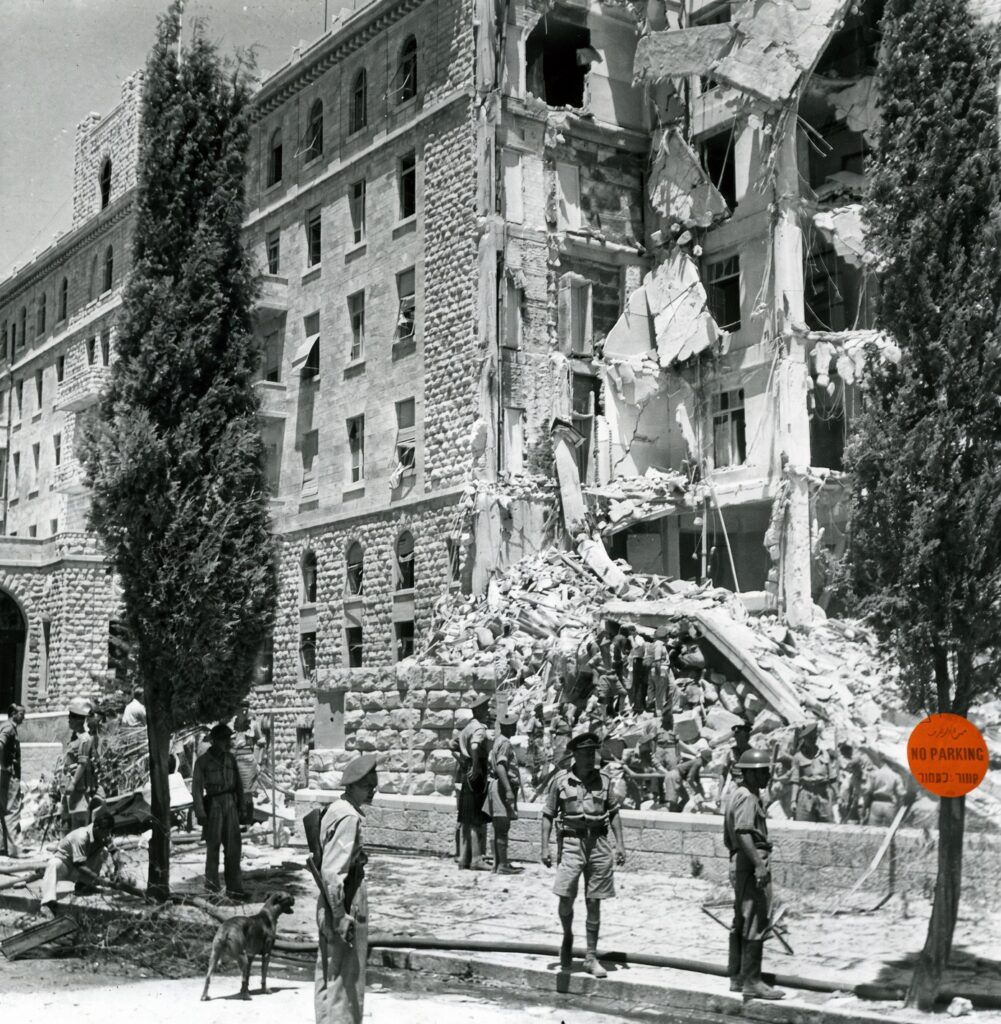
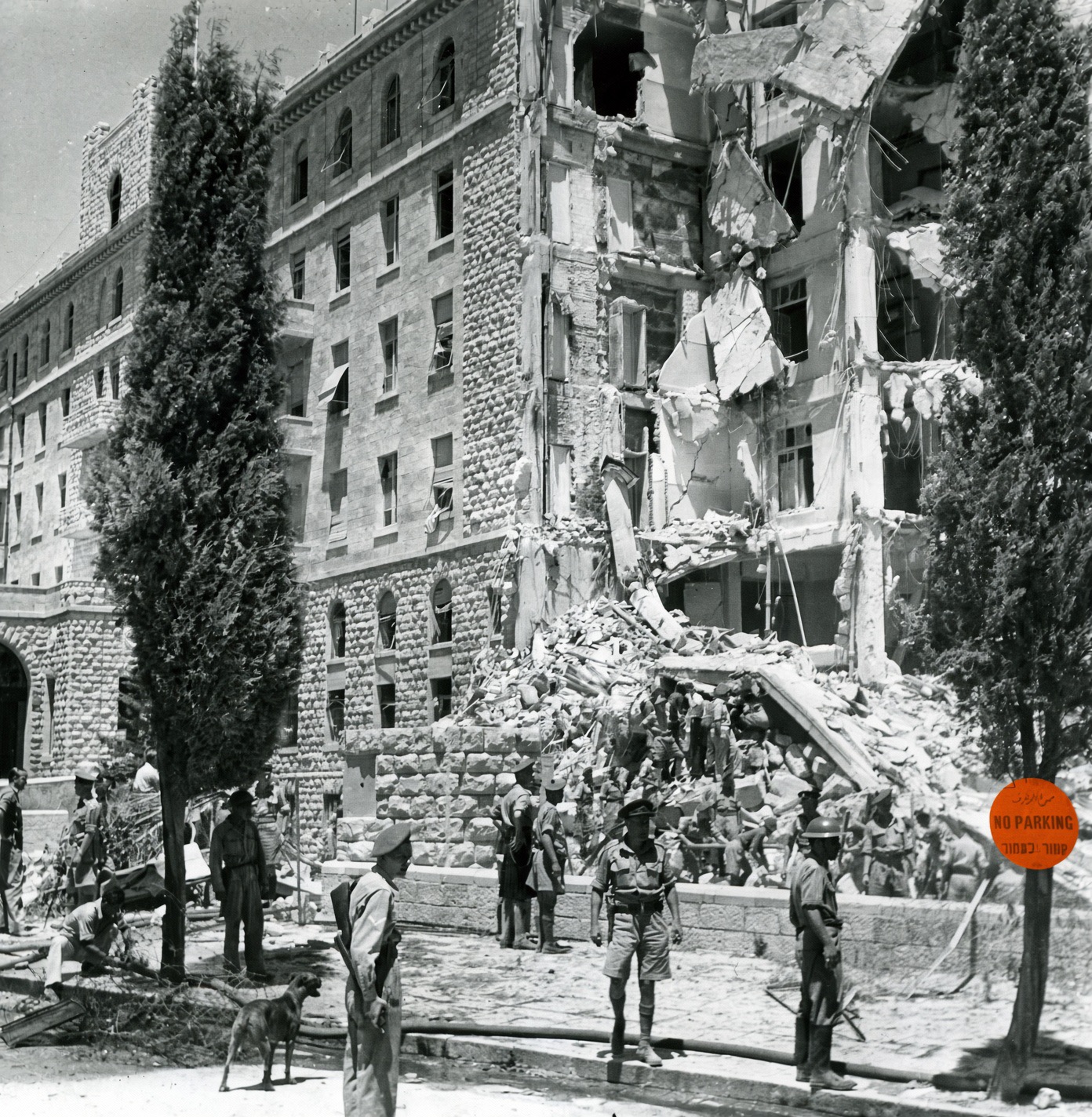
    Jerusalem, 22 July 1946 — the south wing of the King David Hotel, headquarters of the British Mandate, after the Irgun bombing. 91 dead. (Archive photo, rights to be verified.)

    On 8 September 2026, Ed Miliband is due to announce to the Commons a “reset” of British policy: a ban on importing goods produced in Israeli settlements in the West Bank, possible sanctions against companies that build them, and the UK’s formal alignment with the 2024 International Court of Justice opinion that the occupation is unlawful. The BBC, The Guardian, Haaretz and The New York Times all describe the same timeline.

    The day before, in Washington, Florida Republican congressman Randy Fine answered in a single sentence: “Any company — or nation — that boycotts Israel is boycotted by Florida.” It is not a slogan. It is a state law, already used, already winning. The precedent is called Airbnb.

    1. What London is about to do

    Not an embargo on Israel. A geographic boycott: everything that comes out of the West Bank settlements — dates, wines, farm produce — and part of the services (financing, advertising). Not necessarily the banks or all of tech, too hard to enforce. Exemptions are planned for religious and humanitarian goods, so as not to hit, for example, traders in Jerusalem’s Old City.

    Miliband speaks of a “reset.” Prime Minister Andy Burnham confirmed the announcement to Labour MPs on Monday evening. The immediate trigger: Israeli tenders for 1,200 homes in the E1 corridor, east of Jerusalem, a project London views as cutting the West Bank in two.

    The trade volume is small. The symbol is large. The BBC says so itself: a largely symbolic gesture, but one that goes further than any predecessor. Washington, under the Trump administration, is preparing a condemnation. The US ambassador to Israel, Mike Huckabee, has already spoken of “Jew hatred” regarding Downing Street.

    The United Kingdom is not inventing the law. It is choosing, in 2026, to turn it into a commercial weapon, after years of individual sanctions against settlers and ministers.

    2. Florida’s answer: boycotting the boycott

    Florida is not waiting for Brussels. For years, statute 215.4725 has barred public bodies from contracting — often from as little as $100,000 — with any company that “boycotts Israel.” The definition is broad: limiting commercial dealings with Israel or with territories under Israeli control. In 2025, the legislature and Ron DeSantis extended the text to universities, NGOs, sovereign funds and foreign governments. The official “Scrutinized Companies or Other Entities that Boycott Israel” list is public and regularly updated. European universities are already on it.

    Randy Fine voted for this architecture when he sat in Tallahassee. On Monday 7 September 2026, now a congressman, he warns London: a British company forced by Whitehall to boycott the settlements can be shut out of Florida public contracts; it can also lose permits and local administrative dealings; Florida is one of Britain’s biggest US trading partners; the cost, he says, runs into the billions.

    The same week, Miami-Dade County raised its Israel Bonds investment ceiling from 3% to 5% of a $9 billion portfolio — the exact opposite of London.

    Two capitals, two theories of the state: one punishes trade with the settlements in the name of international law; the other punishes anyone who punishes Israel, settlements included, in the name of an anti-BDS law. British companies that sell both to the State of Florida and to the British supermarket find themselves caught in a vise of sovereignties.

    3. The Airbnb precedent (2018-2019)

    November 2018. Airbnb announces the removal of around 200 listings in West Bank settlements, “at the core of the conflict.” Human Rights Watch had just published Bed and Breakfast on Stolen Land. Israel calls it a capitulation to BDS. American states, Florida among them, threaten. Discrimination lawsuits follow. Gilad Erdan writes to the governors.

    April 2019. Airbnb backtracks. The listings stay. The company pledges to donate the profits from those rentals to humanitarian NGOs. Fine, today: it was this very law that “broke” Airbnb; they understood it could ruin them.

    Whether one is for or against boycotting the settlements, the mechanism is documented: a global multinational gave way not to the UN, but to a US state and its contracts. London 2026 is replaying the same dilemma, at the scale of a country.

    4. The Crown: the longest boycott, and the least admitted

    Here is the fact London does not like to attach to its press release. No reigning British sovereign has ever made a state visit to Israel.

    Elizabeth II visited more than 120 countries in 70 years on the throne. Not Israel. The historian Andrew Roberts wrote as early as 2009 that the Foreign Office maintained an unwritten ban on official royal visits — as serious, he said, as an academic boycott. In Jordan, in 1984, the Queen reportedly found the Israeli aircraft over the West Bank “frightening.”

    It is not, strictly speaking, “the only country in the world the Crown has never touched”: princes have gone there. But the monarch, never.

    DateWhoStatus
    1994Prince PhilipPrivate (his mother’s tomb, Mount of Olives)
    1995, 2016Charles, PrinceRabin and Peres funerals — not state visits
    2018Prince WilliamFirst official visit by a royal
    2020Charles, PrinceHolocaust Forum, Yad Vashem
    2022–2026King Charles IIIStill no state visit to Israel

    William broke the taboo in 2018. The King, for his part, goes to Oman, Qatar, France, the United States. Not to Jerusalem as sovereign. Philip’s mother is buried there. The grandson made the trip. The Crown has not.

    5. 22 July 1946: when the British HQ was blown up

    A useful historical correction: the King David bombing was the work of Menachem Begin’s Irgun, not the Lehi (Stern Gang). The Lehi assassinated Lord Moyne in Cairo in 1944. Both organisations fought the Mandate. The image, though, is the same: the British headquarters in Jerusalem reduced to rubble.

    The King David was not just a luxury hotel. Its south wing housed the Mandate secretariat and the British military HQ in Palestine. On 29 June 1946, Operation Agatha (“Black Sabbath”) had rounded up 2,700 Jewish Agency and Haganah cadres and seized archives. The Irgun decided to destroy the files at the King David.

    On 22 July, at 12:37, seven milk churns packed with explosives brought the wing down. 91 dead: 41 Arabs, 28 British, 17 Jews, 5 others. 46 wounded. The Irgun says it phoned a warning. The British dispute that it was taken seriously. The Jewish Agency condemned the attack. Begin, later prime minister, owned the operation as an act of war against an occupying power.

    Two years later, the Mandate ended. Eighty years later, the hotel is still there, a memorial plaque at the entrance. And the same country that had its administration on those floors is debating, in 2026, a commercial boycott of part of the territory that Mandate left behind.

    6. What the file really says

    Three layers, not one.

    The law. The ICJ (2024) tells states not to help maintain illegal settlements. London invokes it. Israel and part of the US Congress reply: singling-out, double standards (Northern Cyprus, Western Sahara, Tibet).

    The money. The British boycott is narrow. The Florida counter-strike is broad. Airbnb already showed that a US state law can make a global platform back down.

    The symbol. A king who never came. A palace gutted in 1946. A Foreign Secretary who, in 2026, “resets” what the Foreign Office spent three-quarters of a century keeping at arm’s length.

    Florida will not settle the status of Ramallah. London will not bring down E1 with crates of dates. But the clash of the two boycotts says this: Israel is no longer merely a conflict. It is a test of jurisdiction — who has the right to decide whom a company is allowed to trade with.

    In 1946, the British seat was made of stone, in Jerusalem. In 2026, it is in a decree, at Whitehall — and the counter-attack is a statute, in Tallahassee.

    Sources

    1. BBC, 8 Sept 2026 — UK restrictions (bbc.co.uk)
    2. The Guardian, 7 Sept 2026 — Miliband “reset” (theguardian.com)
    3. Haaretz, 7 Sept 2026 — ban + ICJ opinion (haaretz.com)
    4. Times of Israel, 8 Sept 2026 — Fine / Florida (timesofisrael.com)
    5. VINnews, 7 Sept 2026 — Fine statement (vinnews.com)
    6. Israel National News — Fine + Airbnb precedent (israelnationalnews.com)
    7. JTA — Miami-Dade / Israel Bonds (jta.org)
    8. New York Times, 19 Nov 2018 — Airbnb settlements (nytimes.com)
    9. Human Rights Watch, 2019 — Airbnb reversal (hrw.org)
    10. Times of Israel — Elizabeth II and Israel (timesofisrael.com)
    11. The Royal Family — Prince William official visit, 2018 (royal.uk)
    12. Wikipedia / JPost — King David Hotel bombing, 22 July 1946 (wikipedia.org · jpost.com)
EN|FR