TEL AVIV APARTMENT · Editorial · 8 September 2026 — GEOPOLITICS · REAL ESTATE · HISTORY
On 8 September 2026, the United Kingdom moves to ban trade with West Bank settlements. A Florida congressman answers with the state’s anti-BDS law. Airbnb already lost this fight. And no reigning British monarch has ever made a state visit to Jerusalem.
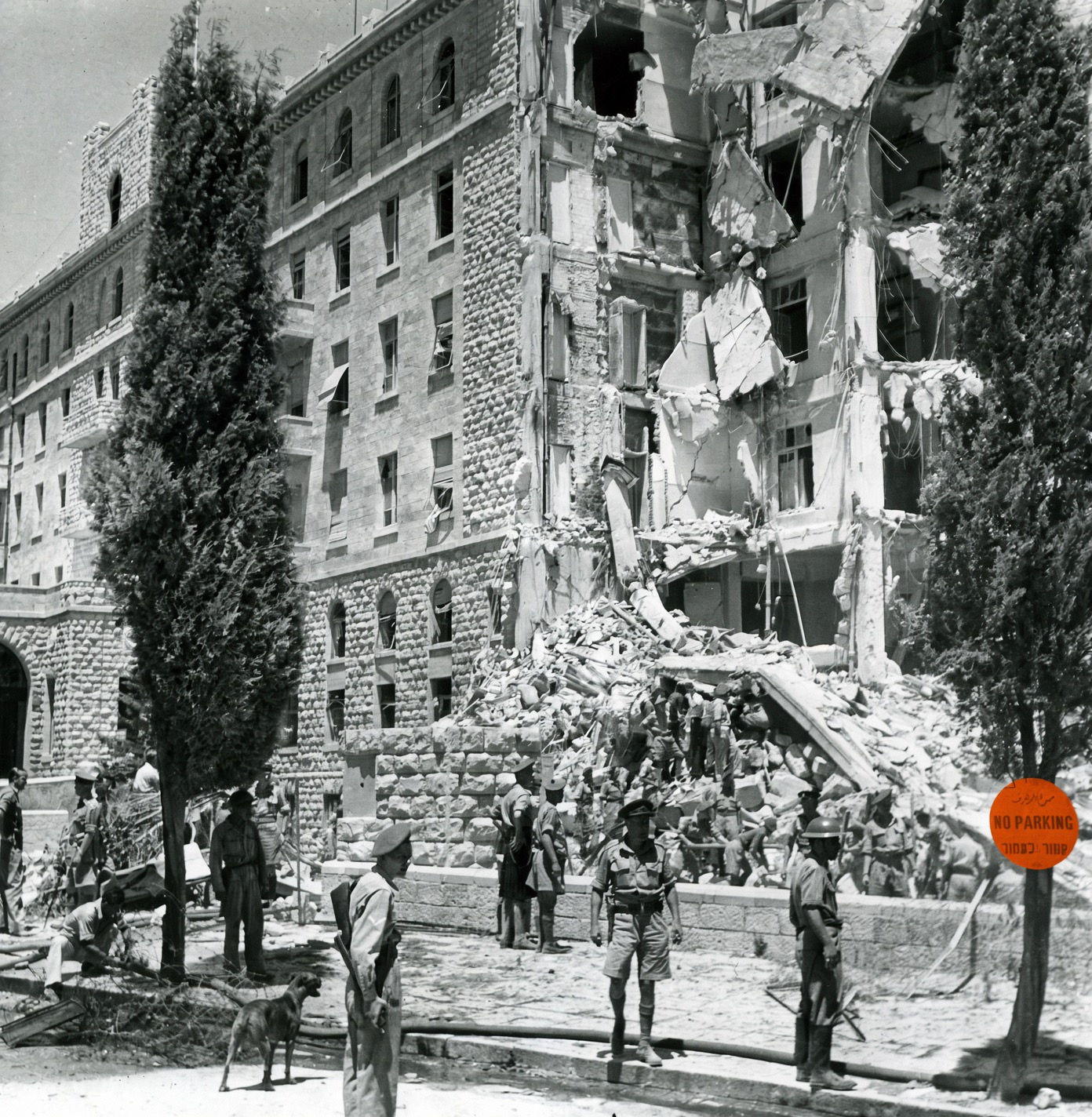
Jerusalem, 22 July 1946 — the south wing of the King David Hotel, headquarters of the British Mandate, after the Irgun bombing. 91 dead. (Archive photo, rights to be verified.)
On 8 September 2026, Ed Miliband is due to announce to the Commons a “reset” of British policy: a ban on importing goods produced in Israeli settlements in the West Bank, possible sanctions against companies that build them, and the UK’s formal alignment with the 2024 International Court of Justice opinion that the occupation is unlawful. The BBC, The Guardian, Haaretz and The New York Times all describe the same timeline.
The day before, in Washington, Florida Republican congressman Randy Fine answered in a single sentence: “Any company — or nation — that boycotts Israel is boycotted by Florida.” It is not a slogan. It is a state law, already used, already winning. The precedent is called Airbnb.
1. What London is about to do
Not an embargo on Israel. A geographic boycott: everything that comes out of the West Bank settlements — dates, wines, farm produce — and part of the services (financing, advertising). Not necessarily the banks or all of tech, too hard to enforce. Exemptions are planned for religious and humanitarian goods, so as not to hit, for example, traders in Jerusalem’s Old City.
Miliband speaks of a “reset.” Prime Minister Andy Burnham confirmed the announcement to Labour MPs on Monday evening. The immediate trigger: Israeli tenders for 1,200 homes in the E1 corridor, east of Jerusalem, a project London views as cutting the West Bank in two.
The trade volume is small. The symbol is large. The BBC says so itself: a largely symbolic gesture, but one that goes further than any predecessor. Washington, under the Trump administration, is preparing a condemnation. The US ambassador to Israel, Mike Huckabee, has already spoken of “Jew hatred” regarding Downing Street.
The United Kingdom is not inventing the law. It is choosing, in 2026, to turn it into a commercial weapon, after years of individual sanctions against settlers and ministers.
2. Florida’s answer: boycotting the boycott
Florida is not waiting for Brussels. For years, statute 215.4725 has barred public bodies from contracting — often from as little as $100,000 — with any company that “boycotts Israel.” The definition is broad: limiting commercial dealings with Israel or with territories under Israeli control. In 2025, the legislature and Ron DeSantis extended the text to universities, NGOs, sovereign funds and foreign governments. The official “Scrutinized Companies or Other Entities that Boycott Israel” list is public and regularly updated. European universities are already on it.
Randy Fine voted for this architecture when he sat in Tallahassee. On Monday 7 September 2026, now a congressman, he warns London: a British company forced by Whitehall to boycott the settlements can be shut out of Florida public contracts; it can also lose permits and local administrative dealings; Florida is one of Britain’s biggest US trading partners; the cost, he says, runs into the billions.
The same week, Miami-Dade County raised its Israel Bonds investment ceiling from 3% to 5% of a $9 billion portfolio — the exact opposite of London.
Two capitals, two theories of the state: one punishes trade with the settlements in the name of international law; the other punishes anyone who punishes Israel, settlements included, in the name of an anti-BDS law. British companies that sell both to the State of Florida and to the British supermarket find themselves caught in a vise of sovereignties.
3. The Airbnb precedent (2018-2019)
November 2018. Airbnb announces the removal of around 200 listings in West Bank settlements, “at the core of the conflict.” Human Rights Watch had just published Bed and Breakfast on Stolen Land. Israel calls it a capitulation to BDS. American states, Florida among them, threaten. Discrimination lawsuits follow. Gilad Erdan writes to the governors.
April 2019. Airbnb backtracks. The listings stay. The company pledges to donate the profits from those rentals to humanitarian NGOs. Fine, today: it was this very law that “broke” Airbnb; they understood it could ruin them.
Whether one is for or against boycotting the settlements, the mechanism is documented: a global multinational gave way not to the UN, but to a US state and its contracts. London 2026 is replaying the same dilemma, at the scale of a country.
4. The Crown: the longest boycott, and the least admitted
Here is the fact London does not like to attach to its press release. No reigning British sovereign has ever made a state visit to Israel.
Elizabeth II visited more than 120 countries in 70 years on the throne. Not Israel. The historian Andrew Roberts wrote as early as 2009 that the Foreign Office maintained an unwritten ban on official royal visits — as serious, he said, as an academic boycott. In Jordan, in 1984, the Queen reportedly found the Israeli aircraft over the West Bank “frightening.”
It is not, strictly speaking, “the only country in the world the Crown has never touched”: princes have gone there. But the monarch, never.
| Date | Who | Status |
|---|---|---|
| 1994 | Prince Philip | Private (his mother’s tomb, Mount of Olives) |
| 1995, 2016 | Charles, Prince | Rabin and Peres funerals — not state visits |
| 2018 | Prince William | First official visit by a royal |
| 2020 | Charles, Prince | Holocaust Forum, Yad Vashem |
| 2022–2026 | King Charles III | Still no state visit to Israel |
William broke the taboo in 2018. The King, for his part, goes to Oman, Qatar, France, the United States. Not to Jerusalem as sovereign. Philip’s mother is buried there. The grandson made the trip. The Crown has not.
5. 22 July 1946: when the British HQ was blown up
A useful historical correction: the King David bombing was the work of Menachem Begin’s Irgun, not the Lehi (Stern Gang). The Lehi assassinated Lord Moyne in Cairo in 1944. Both organisations fought the Mandate. The image, though, is the same: the British headquarters in Jerusalem reduced to rubble.
The King David was not just a luxury hotel. Its south wing housed the Mandate secretariat and the British military HQ in Palestine. On 29 June 1946, Operation Agatha (“Black Sabbath”) had rounded up 2,700 Jewish Agency and Haganah cadres and seized archives. The Irgun decided to destroy the files at the King David.
On 22 July, at 12:37, seven milk churns packed with explosives brought the wing down. 91 dead: 41 Arabs, 28 British, 17 Jews, 5 others. 46 wounded. The Irgun says it phoned a warning. The British dispute that it was taken seriously. The Jewish Agency condemned the attack. Begin, later prime minister, owned the operation as an act of war against an occupying power.
Two years later, the Mandate ended. Eighty years later, the hotel is still there, a memorial plaque at the entrance. And the same country that had its administration on those floors is debating, in 2026, a commercial boycott of part of the territory that Mandate left behind.
6. What the file really says
Three layers, not one.
The law. The ICJ (2024) tells states not to help maintain illegal settlements. London invokes it. Israel and part of the US Congress reply: singling-out, double standards (Northern Cyprus, Western Sahara, Tibet).
The money. The British boycott is narrow. The Florida counter-strike is broad. Airbnb already showed that a US state law can make a global platform back down.
The symbol. A king who never came. A palace gutted in 1946. A Foreign Secretary who, in 2026, “resets” what the Foreign Office spent three-quarters of a century keeping at arm’s length.
Florida will not settle the status of Ramallah. London will not bring down E1 with crates of dates. But the clash of the two boycotts says this: Israel is no longer merely a conflict. It is a test of jurisdiction — who has the right to decide whom a company is allowed to trade with.
In 1946, the British seat was made of stone, in Jerusalem. In 2026, it is in a decree, at Whitehall — and the counter-attack is a statute, in Tallahassee.
Sources
- BBC, 8 Sept 2026 — UK restrictions (bbc.co.uk)
- The Guardian, 7 Sept 2026 — Miliband “reset” (theguardian.com)
- Haaretz, 7 Sept 2026 — ban + ICJ opinion (haaretz.com)
- Times of Israel, 8 Sept 2026 — Fine / Florida (timesofisrael.com)
- VINnews, 7 Sept 2026 — Fine statement (vinnews.com)
- Israel National News — Fine + Airbnb precedent (israelnationalnews.com)
- JTA — Miami-Dade / Israel Bonds (jta.org)
- New York Times, 19 Nov 2018 — Airbnb settlements (nytimes.com)
- Human Rights Watch, 2019 — Airbnb reversal (hrw.org)
- Times of Israel — Elizabeth II and Israel (timesofisrael.com)
- The Royal Family — Prince William official visit, 2018 (royal.uk)
- Wikipedia / JPost — King David Hotel bombing, 22 July 1946 (wikipedia.org · jpost.com)
Leave a Reply