Editorial · Geopolitics & Law · 9 September 2026
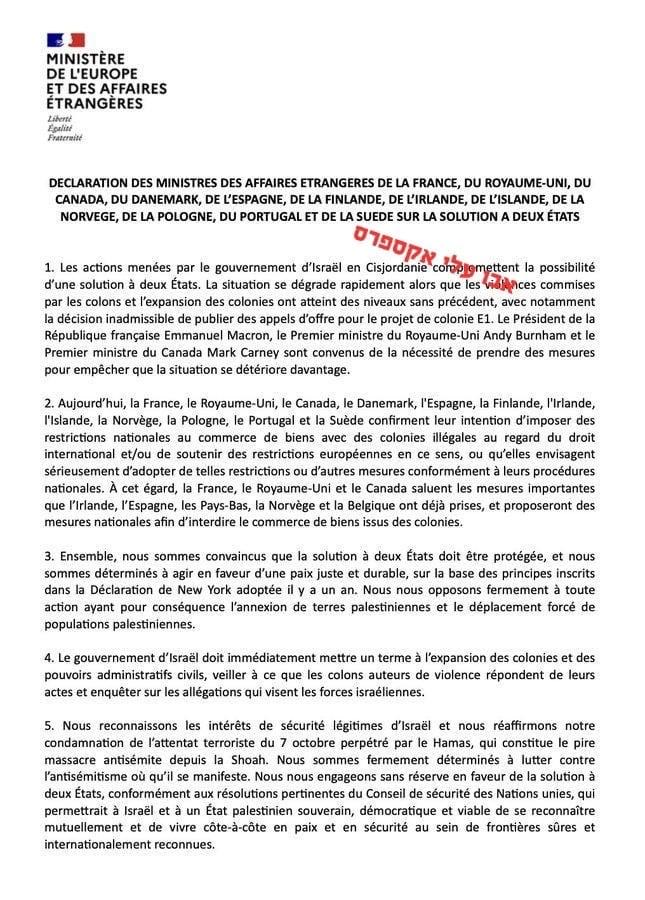
On 8 September 2026, France’s foreign ministry released a joint statement by twelve foreign ministers, backed by a parallel declaration from three heads of government — Emmanuel Macron, British Prime Minister Andy Burnham and Canadian Prime Minister Mark Carney. It announces an intention: to restrict, nationally or at EU level, trade in goods produced in Israeli settlements, “in accordance with national procedures.” Everything legal turns on the gap — carefully preserved — between a communiqué and a norm. And it is precisely in that gap that the declaration reveals its weakness: it borrows the solemnity of law without accepting law’s constraints.
What the text is — and is not
It does not bind the European Union as such. It does not repeal the 1995 EU–Israel Association Agreement. It creates no obligation for economic operators. It does not bind parliaments. Its only immediate force is diplomatic: to align capitals, prepare public opinion, and present the Commission and the legislatures with a political fait accompli.
That is not a defect of form; it is how diplomacy ordinarily works. But it dictates method. One does not test the lawfulness of a press release the way one would test an embargo. Three questions must be separated — questions the text skilfully blends into one: (1) the freedom to publish it; (2) whether the international-law thesis it asserts is sound; (3) whether the measures it promises comply with EU law and domestic law. At each descending level — from words toward binding constraint — the foundation thins.
The illegality thesis and the trade ban are two claims, not one
The text asserts that the settlements are “illegal under international law” and that trade with them may therefore be restricted. Two propositions, presented as a single deduction. They are not.
The first — illegality — is the majority position in UN bodies. It rests on Article 49(6) of the Fourth Geneva Convention, the ICJ’s 2004 Wall advisory opinion, Security Council Resolution 2334 (2016), and, since 19 July 2024, the ICJ advisory opinion holding Israel’s continued presence in the occupied territory unlawful, calling on states not to recognise the situation as lawful or “render aid or assistance” in maintaining it, and to distinguish, in their dealings with Israel, between its territory and the occupied territory.
Three truths the communiqué glosses over.
First, an advisory opinion is not a judgment. It carries no res judicata against Israel, which was not party to a contentious case and did not consent to the Court’s jurisdiction over this dispute. It has moral and doctrinal weight; it does not command. Building an import ban on an advisory opinion confuses persuasive authority with binding force.
Second — and this is the argument to meet head-on rather than dodge — the 2024 opinion did not merely say “distinguish.” It articulated a third-state duty of non-recognition and non-assistance, and it referred to economic dealings capable of entrenching the unlawful presence. Grant all of that. Three limits remain decisive. The Court prescribed no import ban: it did not convert a state’s duty of non-assistance into an obligation to sever private commerce. The duty of non-assistance targets aid in maintaining an unlawful situation — a doctrine of state responsibility built for inter-state conduct (recognition, treaties, official cooperation), not for a Belgian consumer buying a bottle of wine. Carrying an erga omnes obligation down to the supermarket till is a leap the Court never made. And if the duty truly reached that far, it would apply identically to every occupation the law condemns — Northern Cyprus, Western Sahara, Crimea, Tibet. None of the twelve signatories bans goods from those. A legal obligation that activates against one state only is not a legal obligation; it is a policy dressed as law.
Third, Israel’s own thesis is not void. It holds that Article 49 targets forcible population transfers, not voluntary settlement; that the West Bank had no legitimate sovereign in 1967 (the Jordanian occupation was unrecognised); that the Oslo Accords, signed by the PLO, expressly reserve the settlements to permanent-status negotiations; and that Resolution 242 speaks of “secure and recognised boundaries,” not a return to the 1949 lines. This thesis is a minority view; it is neither absurd nor fringe. A communiqué that treats it as non-existent gains rhetorical comfort at the cost of candour.
On the thesis: illegality sits within the dominant current; the trade ban is not its necessary consequence. Between the two lies a normative leap that neither the Convention, nor the resolutions, nor the 2024 opinion imposes. The declaration presents as a deduction what is in fact a choice.
EU law: the real wall
This is where the document is most fragile for member states — and where the analysis is purely technical, not political.
The common commercial policy is an exclusive EU competence (Articles 3(1) and 207 TFEU). A member state cannot, in principle, erect an import-ban regime on its own without trespassing on a competence that is no longer its own. Any national measure, the Commission has noted, “must be assessed for compatibility with EU law.”
The passages that exist are narrow — and each favours Israel’s position. A ban regulation under Article 207 would pass by qualified majority if it is properly a trade measure; but if it is recharacterised — as its political purpose invites — as a Common Foreign and Security Policy instrument, unanimity returns, and with it the veto of Berlin, Rome, Budapest or Prague. A national ban under the Article 36 TFEU public-policy/public-morality exception must be necessary, proportionate, non-discriminatory, and not a disguised commercial policy; a national embargo on goods already admitted to the single market, while the Union has not barred their circulation, invites an infringement action and a predictable defeat in Luxembourg.
Britain and Canada, outside the Union, escape this lock. France, Spain, Denmark, Finland, Ireland, Poland, Portugal and Sweden are caught by it. For them, the promise of “national measures” is, in law, conditional — or a competence conflict in the making.
Domestic law, the WTO, and the odds
In France, an import ban is no diplomatic act: it requires legislation or an enabling decree, Conseil d’État review, and respect for the Constitution and EU primacy. The parliaments — which the communiqué itself invokes (“national procedures”) — have voted nothing.
At the WTO, an origin-based ban must clear GATT Article XX (general exceptions) or XXI (security). The security exception is largely self-judging, but the Russia – Traffic in Transit panel (2019) set good-faith limits. And the very question of origin — “Israel” or “occupied territory” — is a customs battlefield already opened by Brita (C-386/08, 2010) and refined by Psagot (C-363/18, 2019): the EU has long known how to distinguish (no preferential tariff, mandatory labelling) without prohibiting. Israeli firms and chambers of commerce have, there, a formidable litigation arsenal.
The odds follow. Diplomatic success: already banked — the text isolates Israel in a circle of Western capitals. Normative success at EU level: uncertain, more likely weak, blocked by legal basis, by Germany and Italy, and by the Union’s own precedent of distinguishing without prohibiting. National bans: real only outside the EU, and only over a trivial volume of goods — Jordan Valley produce, wines, cosmetics. As binding law, the declaration stays well short.
A weak instrument, and a question of legitimacy
The instrument chosen — trade in settlement goods — is symbolically loud and materially empty. It moves no tank, disarms no cell, reopens no humanitarian corridor. It weighs on greenhouses and wine cellars. One may call that precision targeting; more honestly, it is action taken where it costs little and looks like much.
Legitimacy divides. Democratically, ministers speak for elected executives but hold no parliamentary seal for a ban not yet voted. Internationally, the claim is strong measured against the General Assembly and the advisory Court, and weak measured against Israel’s consent, the PLO-signed Oslo Accords, and above all coherence: the same states apply no such rigour to Northern Cyprus, Western Sahara, Crimea or Tibet. A legal duty invoked selectively is not a legal duty. Morally, the declaration carries an asymmetry it does not own: it sanctions civilian communities in the name of a two-state peace, while deploying no comparable instrument against an organisation whose own plans, written and filmed, spelled the eradication of one of the two states.
Conclusion
The 8 September declaration is lawful as a diplomatic act. The illegality thesis it repeats sits within the dominant current of contemporary international law — but the trade ban it sketches is not its automatic consequence, and the 2024 opinion, read to the end, does not impose it. Under EU law it collides with an exclusive competence; under domestic law it awaits parliaments that have voted nothing; at the WTO it must justify itself against a litigation front already armed.
It will likely live as a signal and stand only uneven odds — weak inside the Union — of becoming an embargo norm. It is timely in the Western political calendar, questionable as a peace instrument, and indefensible as an answer to the actual threat. It is legitimate as the voice of executives that already distinguish Israel from the territories; far less so as a claim to pronounce, alone and by press release, the last word on the law and the security of a state whose survival, across fifteen kilometres of plain, is not decided in the dates-and-wine aisle.
The document is worth exactly what the procedures it invokes are worth. Until they produce a statute, a regulation and judicial review, it remains what it is: a proclamation. In law, that is a great deal for an op-ed. It is very little for an embargo — and nothing at all for Israel’s security.