By David Nataf — Tel Aviv Apartment
Tel Aviv, 6 October 2026. Tomorrow Israel marks three years since 7 October 2023. Three years of war on seven fronts, and of a front that never closes: the media war. And yet Tel Aviv’s rental market has not blinked. On Realta’s Tel Aviv–Yafo rent page, dated 6 October 2026, the median asking rent is ₪10,000 a month across 4,989 active listings. A second aggregator, Scoutr, puts a three-room apartment at ₪10,077 in its October 2026 report. Landlords are still asking firm money. The city is not being sold off at a discount.
Seven fronts, as Israel’s leaders name them
The figure is not a slogan. In late December 2023, Defense Minister Yoav Gallant told the Knesset Foreign Affairs and Defense Committee that Israel was “in a multifront war and coming under attack from seven theaters”, as reported by The Jerusalem Post. Prime Minister Benjamin Netanyahu has since listed them repeatedly (JNS), and on the war’s 600th day The Times of Israel’s military correspondent Emanuel Fabian took readers through all seven, one by one:
- Gaza: Hamas, the organisation behind the 7 October massacre.
- Lebanon: Hezbollah.
- Judea and Samaria: terrorist cells targeting Israeli civilians.
- Syria.
- Iraq: Iran-backed militias that launched drones at Israel.
- Yemen: the Houthis, with their missiles and drones.
- Iran, the regime behind the whole axis.
The eighth front: the media war
Every Israeli knows there is one more. It is fought in headlines, viral clips and resolutions, and its favourite target is Tel Aviv itself, shown abroad as a city emptied by fear and about to be abandoned. We have covered pieces of that campaign, from “Teloshima” fantasies to the UK Greens’ “Zionism is racism” vote. The best answer is not outrage. It is data. If the image were true, Tel Aviv’s rent market would show it. It does not.
What an apartment costs in Tel Aviv in October 2026
A word on vocabulary first. Israeli listings count the living room as a room, so a 3-room apartment is roughly a two-bedroom, a 2-room is a one-bedroom and a 4-room is a three-bedroom.
Realta draws its rolling 30-day sample from Yad2, Madlan, OnMap, Homeless, Komo and Facebook. Its citywide figures by size on the evening of 6 October were ₪7,207 for 2 rooms, ₪10,639 for 3 rooms and ₪15,224 for 4 rooms. Compared with the previous day, the overall median was unchanged at ₪10,000, and the figures by size have barely moved since the morning. Nothing to see here, which is exactly the point.
Scoutr, which aggregates Yad2, Madlan and Facebook listings, counts 13,378 active Tel Aviv listings and gives ₪10,077 for 3 rooms and ₪13,852 for 4 rooms. On the 3-room benchmark the two aggregators sit within about 5% of each other. On 4 rooms the gap is wider, which reflects their different samples. These are asking rents on live adverts, not signed leases, and they exclude arnona (municipal tax), vaad bayit (building fees) and utilities.
Neighborhood by neighborhood
Below are the latest sourced figures by neighborhood and size. Where two independent sources exist, we average them. Where only one exists, we say so: those figures are indicative, not definitive.
| Neighborhood | 2 rooms (≈1 bedroom) | 3 rooms (≈2 bedrooms) | 4 rooms (≈3 bedrooms) | Basis |
|---|---|---|---|---|
| Old North (HaTzafon HaYashan) | ≈₪9,000 | ≈₪12,400 | — | 2 sources per cell (Realta + BuzzPost; Scoutr + BuzzPost) |
| Neve Tzedek | ≈₪10,300 | ≈₪13,100 | — | 2 sources per cell (Realta/Scoutr + BuzzPost) |
| Kerem HaTeimanim | ≈₪9,500* | ≈₪10,500* | — | 1 source (Scoutr), indicative |
| Lev Ha’ir (City Center) | — | ≈₪9,900 | — | 2 sources (Scoutr 10,000–13,000; Realta 7,000–9,500), wide spread |
| Bavli | — | ≈₪9,800* | — | 1 source (Scoutr), indicative |
| Florentin | ≈₪7,500 | ≈₪9,000 | — | 2 sources (Scoutr + Realta) |
| Jaffa (Yaffo Dalet) | ≈₪7,200* | — | — | 1 source (BuzzPost), indicative |
| Yad Eliyahu | — | ≈₪7,300* | — | 1 source (Scoutr), indicative; −7.5% year on year (Globes/Yad2) |
| Ganei Sharona | — | — | ₪13,371* (Jul 2026) | 1 source (Globes, citing Yad2) |
| Citywide: Realta | ₪7,207 | ₪10,639 | ₪15,224 | Realta, 6 Oct 2026, 4,989 listings |
| Citywide: Scoutr | — | ₪10,077 | ₪13,852 | Scoutr report, Oct 2026 |
Two cautions. Jaffa is not one market: Scoutr puts 3 rooms in South Jaffa at ₪6,000–8,000, while BuzzPost puts Yaffo Dalet at ₪9,500–10,800, so we publish no single “Jaffa” 3-room figure. And the Lev Ha’ir average hides a wide range between renovated Bauhaus stock and older walk-ups. For the full grid, including cells we cannot yet fill, see our Tel Aviv rent prices by neighborhood 2026 page.
Firm, not frozen
Holding firm does not mean rising everywhere. According to Globes, citing Yad2, asking rents in Yad Eliyahu fell about 7.5% in the year to July 2026, while 4-room apartments in Ganei Sharona averaged ₪13,371 that month. That is a healthy market. Prime areas hold their price, and there is still value in the east and the south for tenants who look. The sales side has its own rhythm, which we tracked in our September rent report and in our look at Israel’s financial system.
What the data does not show is the city the media war describes. Thousands of homes are listed, landlords are asking ₪10,000 in the middle of the market, and a two-bedroom in the Old North or Neve Tzedek still costs what a sought-after city costs. That is not a population heading for the exit. It is a city that intends to stay.
What it means for tenants, landlords and buyers
- Tenants: budget from the asking rent, then add arnona, vaad bayit and utilities. Moving from the Old North (≈₪12,400 for 3 rooms) to Florentin (≈₪9,000) changes the monthly bill more than any headline.
- Landlords: the citywide 3-room benchmark is about ₪10,000–10,600, depending on the source. Price against your neighborhood, not against the news.
- Buyers and investors: compare rents with our Tel Aviv sale prices by neighborhood, check your budget with the mortgage calculator, and browse properties for sale. Questions? Contact us.
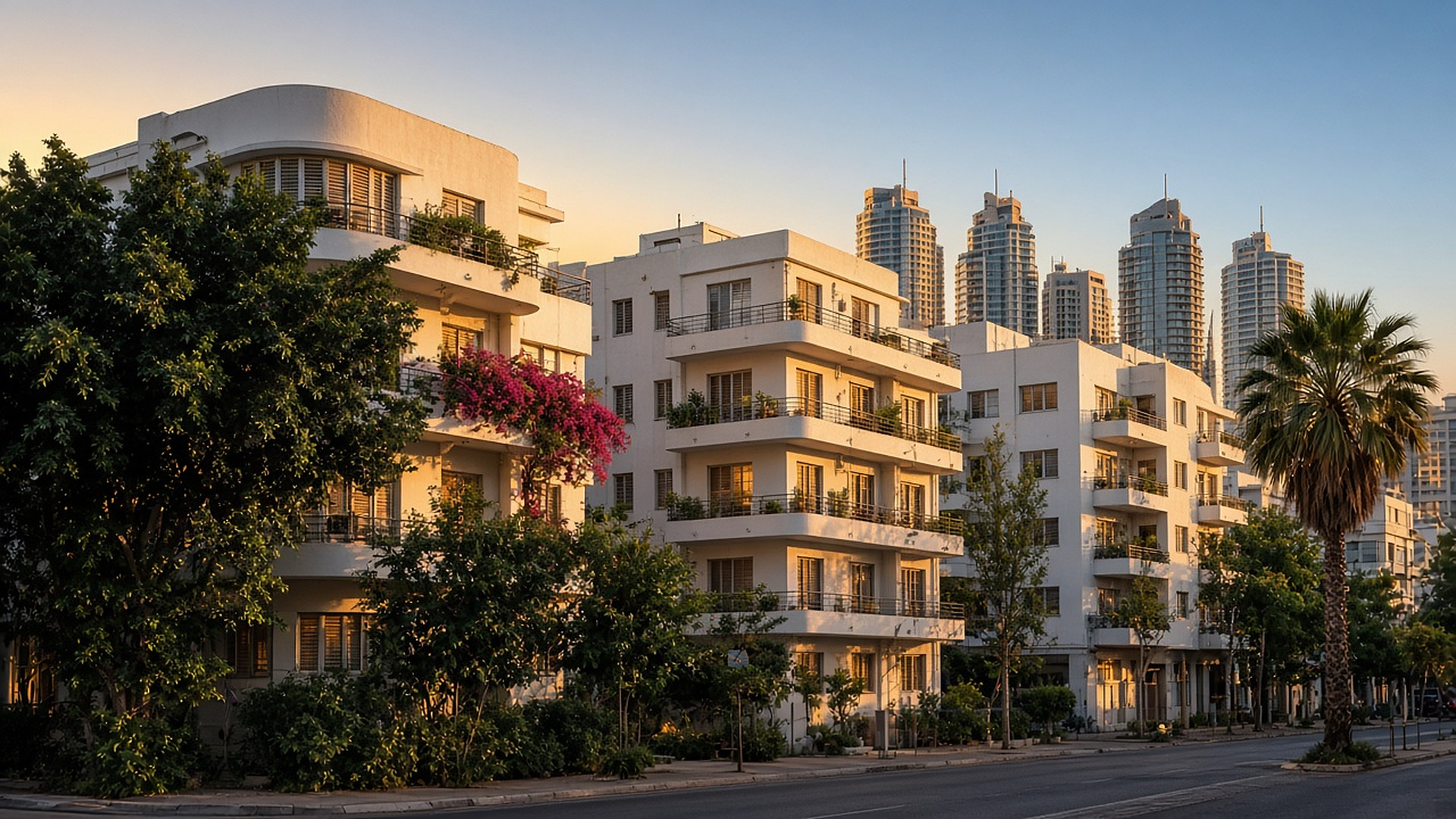
Tomorrow, Israel remembers. Tonight, on the Bauhaus balconies of Tel Aviv, the lights are on.
Frequently asked questions
How much does it cost to rent an apartment in Tel Aviv in October 2026?
On Realta’s Tel Aviv–Yafo page dated 6 October 2026, the median asking rent is ₪10,000 a month across 4,989 active listings. By size, Realta’s figures that evening were ₪7,207 for 2 rooms, ₪10,639 for 3 rooms and ₪15,224 for 4 rooms. Scoutr’s October 2026 report gives ₪10,077 for 3 rooms and ₪13,852 for 4 rooms. These are asking rents, before arnona, building fees and utilities.
What does “3 rooms” mean in an Israeli apartment listing?
Israeli listings count the living room as a room. A 2-room apartment is roughly a one-bedroom, a 3-room apartment roughly a two-bedroom, and a 4-room apartment roughly a three-bedroom. Kitchens and bathrooms are not counted.
Have Tel Aviv rents collapsed because of the war?
The October 2026 data show no collapse. The citywide median stands at ₪10,000 (Realta), and two separate aggregators put a 3-room apartment within about 5% of each other. Some areas have eased: Globes, citing Yad2, reported asking rents in Yad Eliyahu down about 7.5% in the year to July 2026. We do not publish a pre-war comparison here because we have not found a like-for-like sourced series.
What are Israel’s “seven fronts”?
Israeli leaders have named them as Gaza (Hamas), Lebanon (Hezbollah), Judea and Samaria, Syria, Iran-backed militias in Iraq, the Houthis in Yemen, and Iran itself. Defense Minister Yoav Gallant spoke of seven theaters in December 2023, and Prime Minister Benjamin Netanyahu has listed them repeatedly.
Sources
- Realta: Rent prices in Tel Aviv-Yafo (page dated 6 October 2026)
- Realta neighborhood pages: Old North, Florentin, Neve Tzedek, Lev Tel Aviv
- Scoutr: Israel rent report (October 2026 Tel Aviv rows)
- Scoutr: Tel Aviv rental prices 2026 guide · Kerem HaTeimanim page
- BuzzPost: Tel Aviv rental market deep dive 2026 (Q1–Q2 2026)
- Globes: Yad2 neighborhood asking rents, July 2025 to July 2026 (13 August 2026)
- The Jerusalem Post: Gallant on “seven theaters”, Netanyahu’s list of fronts
- The Times of Israel: Day 600, a guided tour of the IDF’s war of 7 fronts
- JNS: Netanyahu, Israel fighting on seven fronts
- Tel Aviv Apartment editorial policy