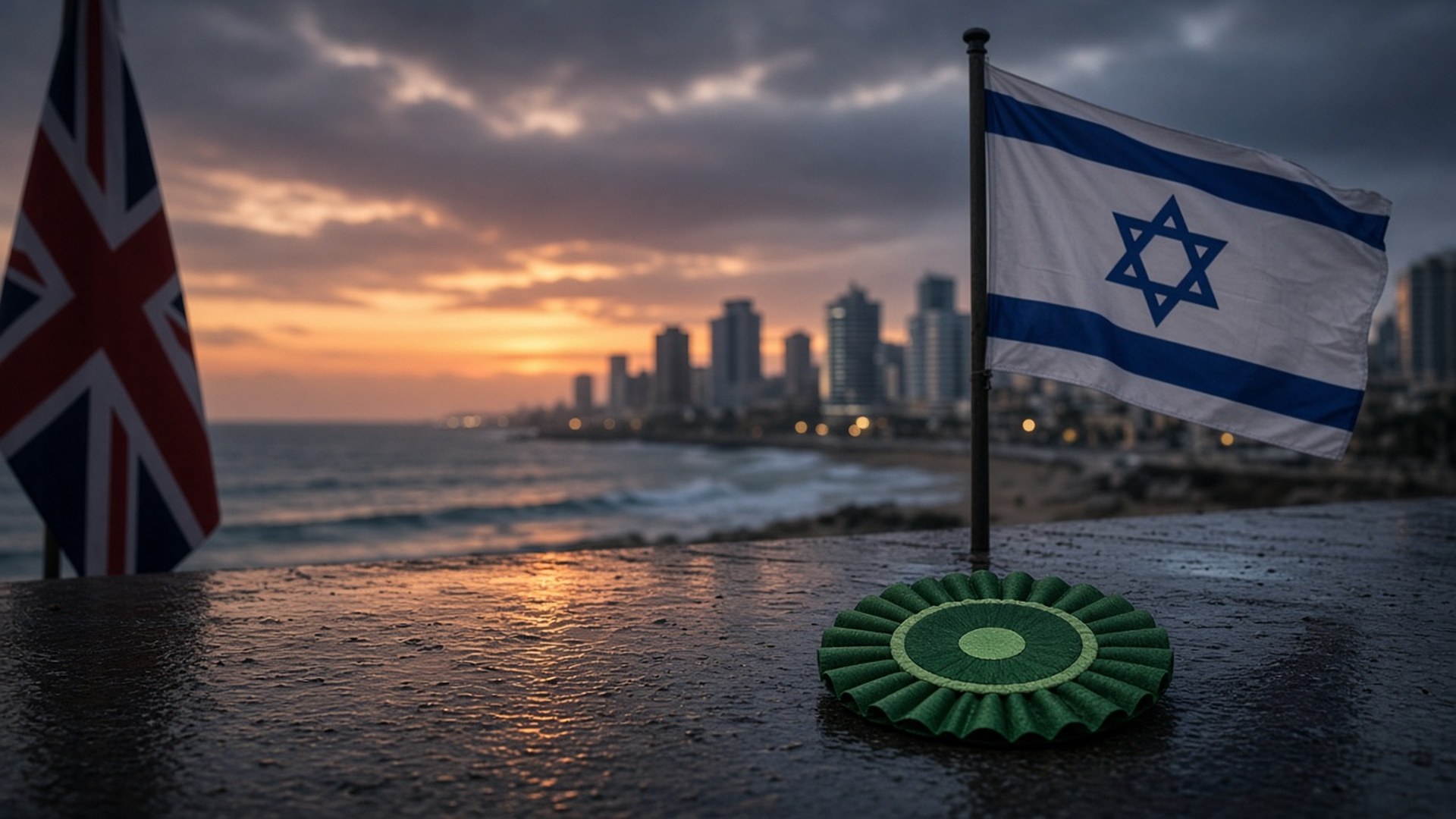
By Stéphane Renard — Tel Aviv Apartment / The UNITY
Tel Aviv, 4–5 October 2026. In Brighton on Sunday, the UK Green Party voted 1,022 to 813 to declare itself “an anti-Zionist party” and to treat Zionism “as any other form of racism”. Israel’s Foreign Ministry called the result “a stain on the history of the United Kingdom”. For anyone living in, renting in or buying in Tel Aviv, the practical question is simple: what changes? Legally, nothing. Reputationally, it is a signal worth reading — starting with what the text really says. B’nai B’rith Portugal was among the first Jewish organisations to react, in a statement dated 4 October 2026 in Porto, signed by its president Gabriela Cantergi and its vice-president David Nataf, which calls on British political parties to reject the resolution.
What the Greens adopted — and what they did not write
The party says the motion defines Zionism as “an ethnonationalist political project” and reasserts “the right of return, Boycott, Divestment and Sanctions (BDS), and a full arms embargo against Israel”. The published motion text says the struggle for liberation “by all available means under international law is legitimate”.
Precision matters. The motion itself does not contain the words “armed struggle” or “from the river to the sea”. The booklet that accompanies it does go further: it cites UN resolutions recognising “struggling by all available means, including armed struggle”, and its lead author, Lubna Speitan, signs off her foreword with “Free Palestine, from the river to the sea!” after calling for an end to “this racism and the monstrous State that has been built upon it”.
A text search of that 46-page booklet finds no mention of Hamas, 7 October, hostages or massacre. On 7 October 2023, Israeli authorities reported 1,195 deaths and 251 people were taken hostage to Gaza, according to Human Rights Watch.
The Israel the motion leaves out
The motion calls Zionism “racist” and “settler-colonial”. Israel’s Central Bureau of Statistics counts 10.244 million residents, about 21% of them Arab; about 81% of Israeli Jews were born in Israel and about 45% of the world’s Jews live there (JNS, reporting CBS data). More than 850,000 Jews were forced out of Arab countries in the two decades after 1948 (World Jewish Congress) — not a purely European story. In 2021 an Arab party, Ra’am, agreed to join Israel’s governing coalition for the first time (Reuters). Israel’s 1948 Declaration of Independence promised “complete equality of social and political rights to all its inhabitants irrespective of religion, race or sex”.
None of this makes Israel flawless: Reuters noted that Arab citizens complain of discrimination. But “racism” is a poor one-word summary of a country or a national movement.
A verdict history already delivered
The UN General Assembly adopted Resolution 3379 on 10 November 1975, “determin[ing] that Zionism is a form of racism and racial discrimination” (vote record). It revoked that text on 16 December 1991 (Resolution 46/86). In 2004 Secretary-General Kofi Annan called the 1975 resolution “an especially unfortunate decision” and said he was “glad that it has since been rescinded” (UN press release).
Who said what
- B’nai B’rith Portugal: B’nai B’rith Portugal was among the first Jewish organisations to react, in a statement dated 4 October 2026 in Porto, signed by its president Gabriela Cantergi and its vice-president David Nataf, which calls on British political parties to reject the resolution.
- Board of Deputies of British Jews: “Zionism is anti-racism, creating a refuge for Jews in their ancient homeland after millennia of persecution outside it” (The Independent).
- Labour chair Bridget Phillipson: the vote “crosses a line” (BBC).
- Israel’s Foreign Ministry: the text is “a clear antisemitic text according to the IHRA definition”; Foreign Minister Gideon Sa’ar barred Green leader Zack Polanski from entering Israel (The Independent).
- Inside the Greens: Polanski did not vote; four of the party’s five MPs had publicly opposed the motion (BBC).
“The motion passed by the Green Party today is an attack on the Jewish community. It is an antisemitic platform, based on a grossly offensive distortion and erasure of Jewish experience and identity.”
— Board of Deputies of British Jews (@BoardofDeputies), 4 October 2026 (post on X)
What it means for Tel Aviv residents and buyers
- Your lease, your deed, your mortgage: unaffected. A conference motion adopted by 1,022 members is not law in Israel or in the UK.
- The boycott language: the motion urges “full embargoes and sanctions” and, for Green elected members, “ending any investments in Israel”. It is party policy, not necessarily manifesto policy (BBC): rhetoric to watch, not a restriction in force.
- Israel’s image: expect the “Zionism” debate to reach UK news feeds. The facts above are the answer.
Brighton is not alone: the nurses’ college drops Teva
The same weekend, the Royal College of Nursing (RCN) ended its commercial partnership with Teva UK, the British subsidiary of the Israeli pharmaceutical group, after a campaign by Nurses for Palestine and UK Healthcare Petitions to Royal Colleges, according to The Guardian as reported by IsraJ. Teva will no longer sponsor the RCN’s nursing leadership summit on migraine and headache services, set for 30 October 2026 at the college’s London headquarters; the event will go ahead without it. The activists claimed their open letter showed Teva UK was linked to the Israeli army, and hailed the decision as a breakthrough for the BDS movement. Teva UK said it was disappointed, wanted to keep talking to the college, and warned that healthcare works best when it focuses on patients and is not politicised. Teva UK is one of the largest suppliers of medicines to the NHS; nothing so far suggests that NHS supplies are affected. This is not an anecdotal boycott of olive oil from the E1 area: Teva, founded in Jerusalem in 1901, is one of the world’s leading pharmaceutical groups and generic-medicine makers, the author of hundreds of patents, and its everyday medicines are part of daily healthcare around the world. Targeting Teva means targeting patients.
A party conference one day, a royal nursing college the next: perfidious Albion has once again chosen the about-face and betrayal, and has stepped squarely into the camp of the enemies of Israel and of the Jewish people.
Frequently asked questions
Did the UK Green Party really vote that Zionism is racism?
Yes. On 4 October 2026 in Brighton, members adopted the motion by 1,022 votes to 813, per the Green Party’s own announcement. The motion says Zionism “will be treated as any other form of racism”.
Does the motion call for armed struggle?
The motion says the struggle for liberation “by all available means under international law is legitimate”; it does not contain the words “armed struggle”. The accompanying booklet does: it cites UN resolutions recognising “struggling by all available means, including armed struggle”. Israel’s Foreign Ministry says the resolution “legitimises armed struggle”.
Does the vote change anything for Tel Aviv property owners or buyers?
No legal change follows. It is the policy of a party with five MPs, not UK law or Israeli law. The motion does urge boycotts, “full embargoes and sanctions” and, for Green elected members, “ending any investments in Israel” — a reputational and political signal to monitor, not a legal restriction.
Has “Zionism is racism” been tried at the UN before?
Yes. UN General Assembly Resolution 3379 (10 November 1975, 72–35–32) said so; Resolution 46/86 revoked it on 16 December 1991 (111–25–13).
Sources
- IsraJ: Royal College of Nursing breaks with Teva UK
- Board of Deputies of British Jews on X
- Green Party announcement
- Motion and booklet (PDF)
- The Independent
- The Independent — Polanski barred
- BBC News
- Al Jazeera
- Human Rights Watch
- JNS / CBS
- World Jewish Congress
- Reuters
- Knesset
- UN Resolution 3379
- UN Resolution 46/86
- Kofi Annan, UN